World War 1
Palestine, Beersheba and El Foka
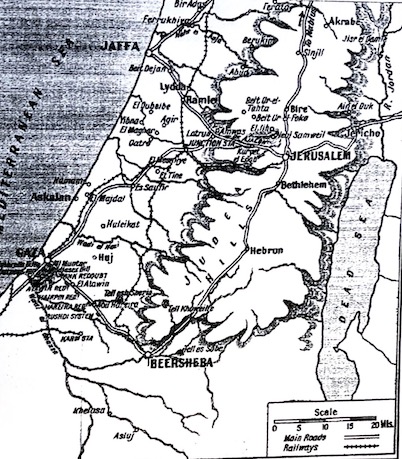
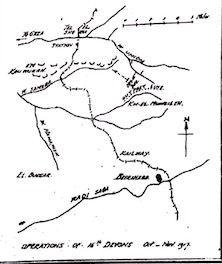
The area where the 16th Devons were involved in the battle for Beersheba.
The 74th Division was not employed in the pursuit of the enemy and on the morning of the 10th November moved to Karm where they remained in training until the 17th. They then moved to St. James' Park, south of Gaza. On the 23rd the battalion left Gaza and going through Mejdel, Khurbet Suiereir, Junction Station, Latron and Beit Sirh, reached Beit Likia — 60 to 70 miles north east of Gaza — on November 30th. The march itself was uneventful but the change from soft sand to hard stony roads played havoc with the men's feet.
The Turks had been driven to the banks of Auja and their left wing driven into the Judean mountains. However their resistance was beginning to stiffen and in some places had forced the British lines back. It soon became clear that the capture of Jerusalem was not going to be a formality and plans for battle would need to be drawn up.
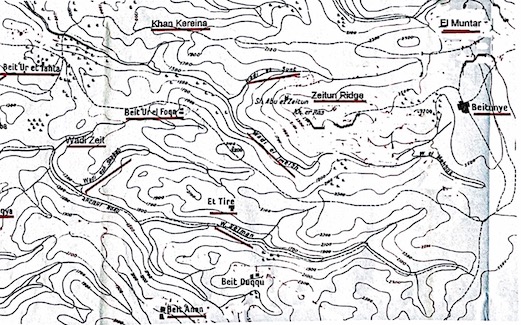
The Cavalry Division holding the Foka—Tahta—Suffa line came under heavy attack and after putting up stout resistance was forced to give up el Foka. A line was established along a wooded ridge between Foka and Tahta (Lower Beth Horon). Here the landscape was of terraced hills, of narrow valleys between steep, precipitous ravines, and of ridges like walls.
On arrival the Devon Yeomanry went into reserve but on the 1st December "A" — Bob's unit — and "B" Companies were sent to reinforce the Fife and Forfar Yeomanry who were in the line opposite el Foka. In the past two days el Foka had already been retaken and lost again. Colonel Marden, the battalion commander, was ordered to take and hold el Foka. All agreed that the first part of the order was comparatively straightforward but to hold the village was a totally different matter.
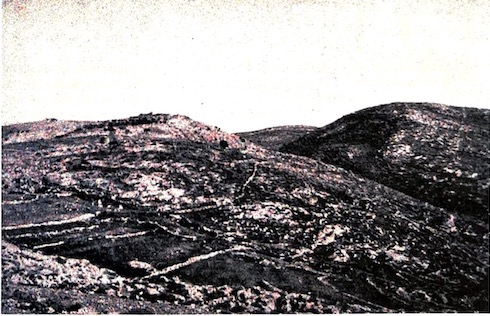
Beit Ur el Foka.
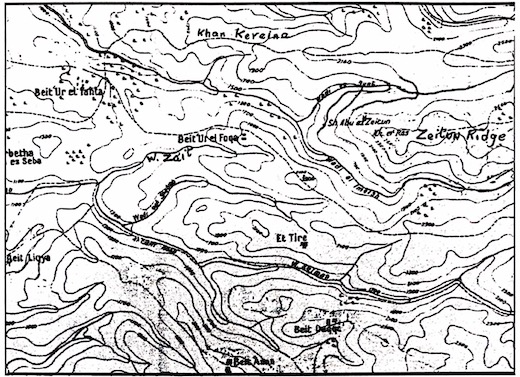
El Foka Region.
El Foka, the Beth Horon of the Old Testament, was a village set on top of a precipitous barren hill eleven miles north-west of Jerusalem. Surrounded by a wall at breast height the village was built on a high escarpment projecting north-west from the Judean Hills and flanked by the Wadis Zeit and Imeish. From three sides the land sloped steeply down to the valleys and ravines below. The location dominated the ancient main pass from the coast to Jerusalem and overlooked the surrounding hills. It also possessed two deep and reliable wells. The approach to el Foka would have to be along the top of the ridge but even then the ground was uneven, rough, stony and strewn with boulders.
A reconnaissance had to be carried out and as "A" and "B" Companies were already in line they were detailed to lead the attack and reconnoitre the approach to the village. On the 2nd, "C" and "D" Companies moved from their bivouac near Beit Likia to meet with "A" and "B" at the junction of the Wadis Zeit and Selman. A "carrying party" from the Ayr and Lanarkshire Yeomanry also joined them. Packs were deposited and an ammunition dump established. Orders were carefully scrutinised and after a brief wait the battalion moved off at 11.15 p.m. for their two mile trek up the Wadi Zeit — "A" and "B" leading, "C" in support and "D" Company in reserve.
It was now very dark and the men had a long and difficult climb in front of them. The route was such that the whole battalion had to move forward in single file. At midnight they emerged on to the bare hill some 400 yards from the village and deployed for the assault in silence, not a shot having yet been fired. Apart from the howl of the hungry jackals away in a wood not a sound could be heard. Of the Turks there was neither sight nor sign. It was still very dark and bitterly cold but soon the moon appeared and lit the scene. The boulder strewn, rough uneven ground with its terrace walls sloped steeply up to the village now glowing white in the moonlight.
At 1.00 a.m. on the 3rd, the attack was launched led by "A" and "B" Companies. It was a desperate scramble over the steep broken ground as they climbed from terrace to terrace under heavy machine gun and sniper fire. Progress was slow but after two hours of bitter fighting the target was reached. Just before 3.00 a.m. the battalion burst through into the village. Savage hand to hand fighting followed with bayonet and grenades being the main weapons. Although the Turks resisted stubbornly they were eventually driven from the village and el Foka was again in British hands.
After their long haul up the hillside followed by the fiercely contested battle the men were nearing exhaustion. Much however still had to be done. The battlefield was strewn with the dead and wounded. Defences had to be organised but the first counter attack came before much consolidation had taken place. Turkish bombers pressed into close quarters but were repelled with bayonet and bombs. Frantic efforts were being made to maintain supplies of grenades and small arms ammunition from the dump established in the Wadi Selman which, in turn, was replenished from stores held at Beit ur Tahta. But as fast as supplies arrived they were used up.
With the arrival of daylight, at around 5.00 a.m., it became obvious that they were in a precarious position. Eastwards across the Wadi Imeish, at a distance of 1,500 yards, was the Zeitun Ridge, several hundred feet higher than el Foka. To the north-west was Khan Kereina, as high as el Foka and about 2,000 yards distant. Both these places were occupied by Turkish troops who included heavy artillery among their armoury. The most dangerous feature, however, was an unnamed hill, designated 1750, only 500 yards away. It was separated from el Foka by a deep ravine. This hill was supposed to be in the hands of the Fife and Forfar Yeomanry but owing to the inaccuracy of their maps the Scottish battalion was nearly a mile to the rear of the location. During the night, after the capture of the village, the Turks had crept around the Devons' flanks and set up a machine gun post which not only enfiladed the Devons' position but also swept the open ground at the rear of the village over which the Yeomen had launched their attack the previous evening. Now their supply lines were threatened and their means of escape from the village was cut off.
In effect el Foka was wide open to gunfire from three sides. To add to their discomfort the situation inside the village was not good. The place was too small to hold a battalion and so conditions were very cramped. No digging was possible owing to the rocky nature of the ground, making it very difficult to construct shelters or defences.
At around 6.00 a.m. the Turkish bombardment began. Artillery, machine guns and rifle fire pounded the Devons. At 7.00 a.m. artillery support was called for but because the British batteries were so far in the rear and unable to move forward owing to the terrain, the first two shells which should have passed over the village landed right among the Devons, knocking out a Lewis gun section — six men and their gun. An urgent message was telephoned to headquarters to increase the range or to stop firing. At first the casualties were light but as the Turkish gunners improved their range shelling became more accurate and the casualty rate increased. Shell after shell now landed directly on the village. Shrapnel and fragments of stones and rocks were flying in all directions along with the hail of bullets from the machine guns and rifles.
Earlier in the morning large columns of Turkish infantry had been seen coming down the hills on the other side of the Wadi el Imeish. As they went lower into the valley they were lost to sight, and out of reach of the British gunners they prepared to attack. Swarming up the steep face of the wadi which protected them completely from the 74th Division's artillery, the Turks attacked again and again, coming in at close quarters to dislodge the Devons. Seven attacks were repelled that morning in brutal hand to hand fighting. Trooper Hodges, who later became postmaster at Withypool, killed six Turks with his bayonet.
At midday the intensity of the artillery and machine gun barrage increased considerably and it was becoming obvious that their position was untenable. Consideration had to be given to withdrawing. With this in mind immediate attention was concentrated on the machine gun post on Hill 1750 that the Turks had set up during the darkness, capable of enfilading the Yeomen's escape route. They had chosen the position wisely, being strategically very well placed and totally protected from the Devons' gunfire. The deadly obstacle had to be removed — a task which could only be achieved by venturing out from the village, crossing no man's land and attacking the post from a different angle. Bob volunteered to undertake this mission and set off with his Lewis gun. Moving through this difficult territory carrying a 12 kg (26 lb) machine gun and using all the skill and care he could muster, he came up behind the Turks within ten yards of their position. Sheltering behind a rock he fixed his gun, took aim, opened fire and wiped out the post.
Afterwards he found three bullet holes through his uniform. One was through his jacket, another through his sleeve and the third through his knapsack. The last pierced an oil can and a tin of corned beef which, now polluted with oil, had to be thrown away — much to Bob's chagrin. A small price to pay for surviving such a dangerous but crucial and successful operation. It was for this action that Bob was awarded the Military Medal.
At 1.30 p.m. permission was given to withdraw. The retreat was carried out in an orderly and well disciplined manner although they were under fire from the advancing Turks who were at times within 300 yards range. The Yeomen fought a good rearguard action enabling the battalion to evacuate the village successfully. As the men moved over the slopes to Wadi Selman they were assisted by the machine guns of the 10th Division providing overhead fire. At 4.30 p.m. they marched off from the Wadi Selman to the bivouac area on the Beit Likia—Beit Anan road.
Bob, however, was not part of this retreat, which had taken place while he was dealing with the machine gun post. He had to make his own way back — a task calling upon his reserves of strength, ability and determination. Again he succeeded and eventually rejoined the others at the bivouac.
That the affair was a catastrophe was not the fault of the Yeomanry. Although defeated they had fought valiantly and won the admiration, and sympathy, of other battalions and those in senior command. Fifty-two of their men had been killed, one hundred and forty-one wounded, fifteen wounded and missing and another seventy-eight missing. A total casualty list of nearly three hundred men.
Early on the morning of the 4th General Hoare, the Brigadier, paid an informal visit to the battalion and congratulated the Devons on their gallant stand. Later that day the G.O.C., 20th Corps, Sir Philip Chetwode, wired his appreciation: "Will you tell the 16th Yeomanry Battalion Devon Regiment that I fully appreciate their gallant conduct in the affair at Foka." The following February, when he visited the Battalion to present awards won at el Foka, he said that the battle was "the biggest engagement of any battalion in the corps" and that he had since learnt that on that day the Turks had sustained 1,100 casualties. The G.O.C., 74th Division, Major General Girdwood, wrote praising their gallantry and on the 6th he visited the Yeomen and congratulated them on their conduct.
For a few days the Devons were placed in reserve but at 5.00 p.m. on the 8th December they moved out and at 5.00 a.m. the next morning took over the front line trenches ready to take part in the final move towards Jerusalem. On that day, however, Jerusalem surrendered and two days later General Allenby made his official entry into the city.
On the 10th the battalion left Tel el Ful and returned the next day to Beit Iksa and bivouacked east of the village. They remained here for a fortnight and were employed in road making or, for the specialists, further training.
At 6.00 p.m. on Christmas Eve the battalion set off for the Wadi Selman where they arrived at 2.00 a.m. on the morning of Christmas Day. During the whole of the march it rained heavily and it continued raining throughout the day. They remained bivouacked at Wadi Selman but Christmas was a miserable affair. Christmas dinner was rain-soaked bread and one rabbit between eight men. Their only entertainment for the day was "standing up and singing songs."
Plans were now being made to drive the enemy further north so as to be better placed to defend the territory they now held. The 74th Division advanced from the el Tireh—Beit ur el Tahta line in a north easterly direction. The route taken by the 229th Brigade was up the Wadi Zeit, past Foka, down into and across the Wadi Omeish and up to the Zeitun Ridge. The Devon Yeomen were in support, but later that day they were put into the line to fill a gap between the Fife and Forfar Yeomanry and the Somerset Yeomanry. There was little fighting until evening when they pushed forward to capture Bir es Shafa.
This attack on the 27th coincided with a Turkish counter-attack further to the east, made with the intention of recovering Jerusalem. The attack was repulsed, with enormous losses to the enemy, by the 53rd and 60th Divisions.
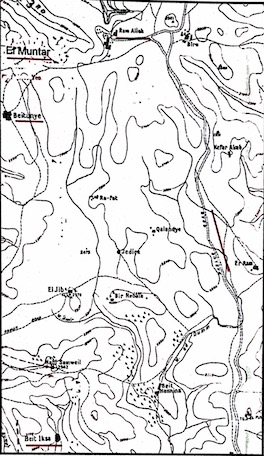
The success of the 10th and 74th Divisions was vigorously pressed home on the following day to take advantage of the disarray now within the enemy lines. The villages of Beitania and el Muntar fell to the 229th Brigade but the Devons were not seriously engaged in the action. On New Year's Day they were relieved after holding the outpost line north-west of Birch. Their activities since December 27th had resulted in 21 casualties, of whom 2 were killed.
On New Year's Day, 1918, the battalion marched, again in heavy rain, to el Tahta where they bivouacked. Whilst en route a burial party with their padre searched for bodies in el Foka and found and buried eighteen.
There was now a pause in the fighting. The Turks were in no position to take offensive action and the British took advantage of the respite to consolidate their position. An important part of this work was road making and for the next two months the Devons were engaged on this in the Yalo area. At the beginning of March the brigade moved up to the front but again only to be used in repairing the Nablus road. However on the 14th March the 229th Brigade took over the front between Kefr Malik and the Nablus road but the big offensive which had been contemplated was abandoned. On April 4th the Devons relieved the West Somersets in the line but no sooner had they done this when orders were received for the 74th Division to transfer to France.
The position in France was becoming more serious. On March 21st the Germans had launched a successful offensive and the Western Front was urgently in need of more troops. The decision was taken to withdraw troops from Palestine, where the allied cause was going well, for service in France where a dangerous situation was developing.
Consequently, on the 9th April, after a quiet spell of duty, the battalion was relieved by the Sussex Yeomanry. On the 10th the Devons moved to Ram Allah and, passing through Suua and Latron, reached Ludd on the 13th after a very hot and tiring march. Here the whole division concentrated and on the 15th entrained for Kantara where they arrived on the morning of the 17th. On the 29th April the battalion entrained at Kantara Station for Gabbary Docks and on the 30th embarked on H.M.T. Leasowe Castle for France.
The Area North-West of Jerusalem
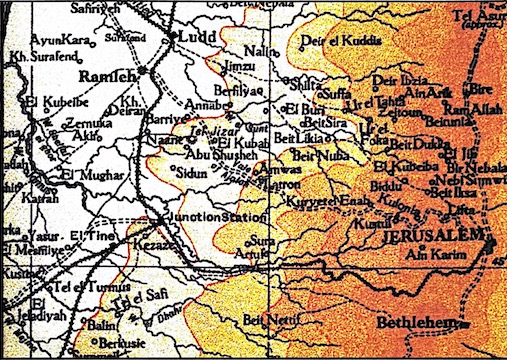
The area in which the Devons operated during the last five months of their time in Palestine. Below and overleaf are larger scale maps of this area with some of the places referred to in the narrative underlined in red.
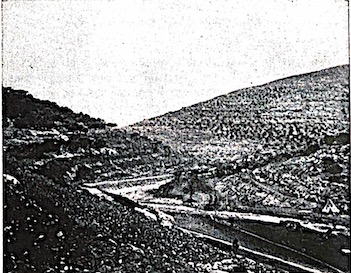
Palestine — The Nablus-Jerusalem Road.
[Continues in Allenby's Men]