World War 1
Robert Coppin Renals M.M.
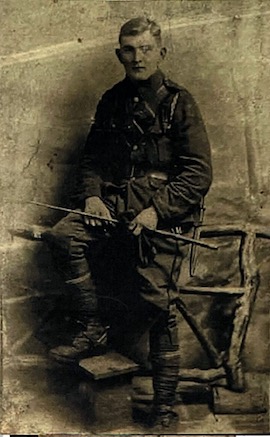
"D" Squadron of the Royal 1st North Devon Yeomanry was a Cornish contingent under the command of Lord Vivian of Glynn. Commander of No.2 Troop of the squadron was the Hon. Victor Agar-Robartes and his men comprised Bodmin and Wadebridge area yeoman. Officers and men were in the main landowners and farmers and the Devon Yeomanry was essentially a cavalry regiment. One common factor united these men — their passionate love for, and knowledge of, horses and the countryside. It was probably this characteristic which led them to join a Devonshire regiment rather than their own county regiment the Duke of Cornwall's Light Infantry. Ironically, early in the war the Devon Yeomanry became part of an infantry regiment and from their first engagement to their last they fought and trained as infantry men.
Robert (Bob) Renals enlisted as a territorial in the Royal 1st Devon Yeomanry on the 2nd November 1912 becoming 2019 Private R. Renals. During his pre-war service he trained as a cavalryman and took part in the camps held at Bovey Tracey and Salisbury Plain carrying out exercises with gunners and infantrymen as well as other yeomanry regiments. Their pale blue serge uniforms were later replaced by khaki and Bedford cord breeches which became the normal uniform.
At 7.00 p.m. on the evening of August 4th, 1914 the Royal 1st Devon Yeomanry received the order to mobilise for what became known as World War 1. Bodmin had been until then the Troop's headquarters and the men drew their supplies, equipment and saddlery from the stores which were situated under the Bodmin Public Rooms.
On Tuesday August 11th mobilisation was complete and that afternoon the men left to travel by rail to Winchester. The 1st Devon Yeomanry and the Royal North Devon Hussars comprising of 469 and 459 men respectively were joined by the West Somersets at Winchester to form the 2nd South-West Mounted Brigade. Their stay at Winchester was very brief as orders had been received to proceed to the East Coast as a German invasion was imminent. By the 15th August the Royal 1st Devons were billeted at St. Osyth and with the others of the 2nd South-West Brigade were in position to defend the outlying portion of Essex between the estuaries of the Stour and Colne.
The threatened invasion did not materialise but preparations continued apace. Guards were provided, defence posts set up and roads and coasts were patrolled. At the same time training was carried out along with incessant drilling, parades and field days. Rumours of raids and invasions continued and just before Christmas, 1914 another such scare resulted in the brigades having to parade at 4.00 a.m. each morning, including Christmas Day, in readiness to repel the invaders.
No soldier was allowed to proceed more than half a mile from his billet unarmed whether on or off duty. Sentries were empowered to fire at all persons who did not answer when challenged and "could fire at any time … if attacked, and could stop and examine any vehicle." Not surprisingly being under such orders resulted in a number of unfortunate incidents and more than once regimental orders had to issue cautions to the over-zealous. The 1st Devon orders for August 22nd stated: "A Court of inquiry will assemble at the Brigade Office at 10.00 a.m. on the 23rd instant, for the purpose of inquiring into, and reporting upon the circumstances under which an inhabitant of Elmstead Market sustained a gunshot wound on the 21st instant." The result is not recorded.
Although the men were kept busy as time went on they became bored and frustrated. In an attempt to relieve the monotony Major Greig had some staghounds sent up from the Devon and Somerset kennels and ran drags or a day's hunting from time to time. Unfortunately, early in the winter, the use of Government owned horses for these purposes was forbidden. Frequent promises of action overseas came to nothing. The closest the Devons came to the enemy was when the Zeppelins made an occasional sortie over the area.
Few photographs exist of Bob's army life. The following were taken either at his territorial camps or during his time in Essex. They were produced as postcards and the messages written on the backs are, for the most part, still legible. In the first photograph, Bob is sitting in the back row on the extreme right and the card was sent to his father at Poplars Cottage, Fletchers Bridge. The only part of the postmark which can be read is "St. Osyth". Bob writes: "Dear Father, I got the £2 all right. We shan't be shifted for a bit now I don't think. We hear all sorts of yarns. I must thank you very much for …"
Unfortunately the last few lines have become obliterated.
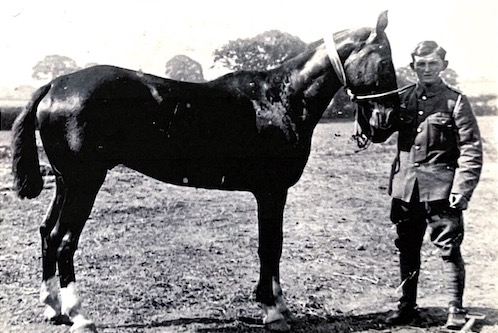
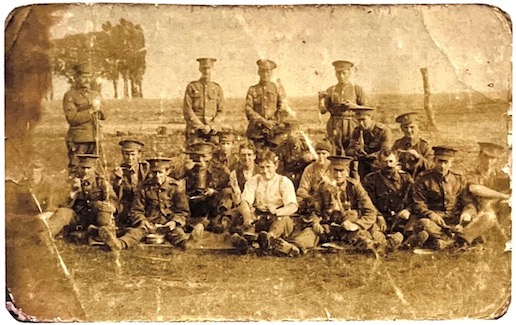
The next photograph is a postcard sent to Poplars, Fletchers Bridge. The postmark reads "Colchester" and the date, which appears to be "28 Sep 14", places it during their period in Essex. Bob is in the front row, sitting second from the right, with his cup and plate in front of him. This card was sent to his brother Fred and reads:
"Dear Fred, show it to Mr. Bonney. I am sending you our photograph of our troop at dinner. I am getting on fine. Everyone here has volunteered and in good heart. I got my sweater and butter and cakes. They came in proper next morning. We were called out at 3.45 a.m. so I took the cakes."
From your brother, Bob.
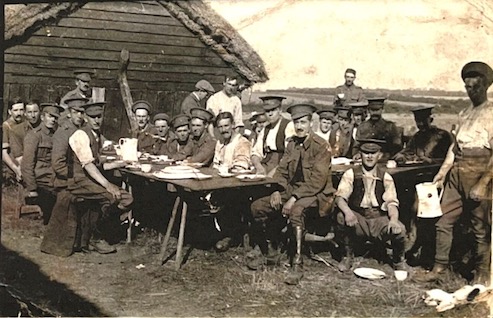
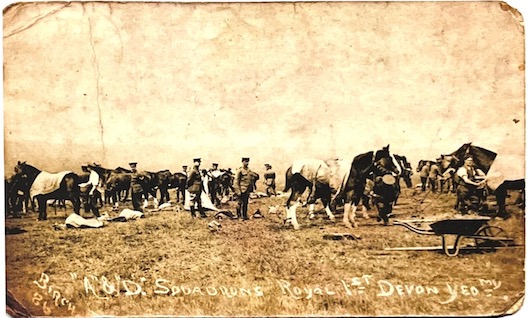
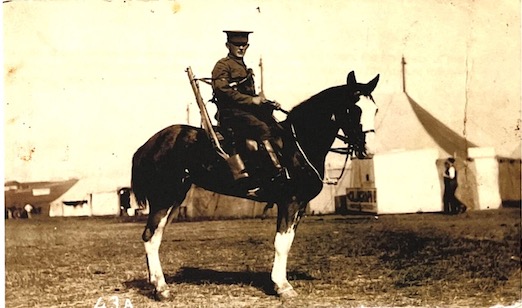
The following two pictures were taken in May 1913 at Larkhill Camp on Salisbury Plain. Again they are postcards but only the first has been used as such. This one was sent to his eldest sister Rachael (Ray) at Poplars Cottage, Fletchers Bridge and reads:
"Dear Ray, I am getting on fine. I was too late to have my mug taken. Nice weather, some hot. I haven't got much to say."
Bob.
From that we take it he was the one ducking under the horse's head in the front of the picture. The second picture shows him mounted, fully equipped, on the same horse.
[Continues — more to follow]