World War 1
Gallipoli
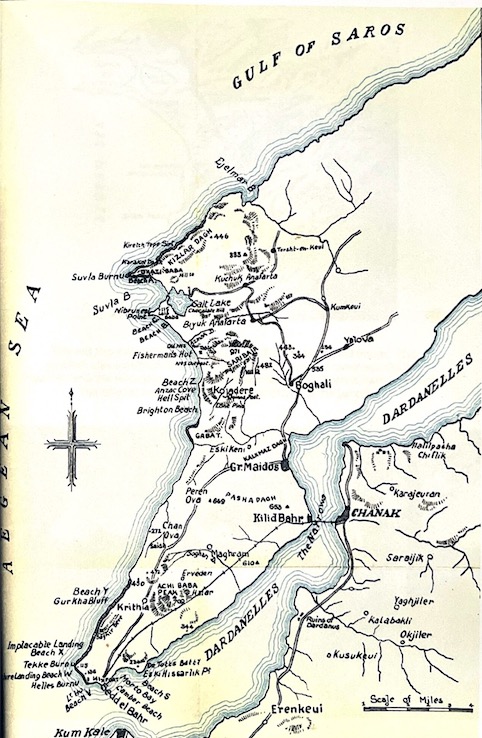
On Saturday 25th September the Olympic sailed down the Mersey and headed out to sea with an escort of three destroyers. The boat deck was forbidden to all save the machine gunners, some of whose guns were mounted there for protection against enemy submarines. The first day at sea closed with a lovely sunset and both the Irish and English coasts were visible. Captain Money-Coutts asked Major Greig, an Exmoor man, if they were, in fact, viewing Exmoor. The Major replied, "It's the last some of us will see of the old Moor, I expect." Within days of landing at Suvla Bay he was killed by a shell while directing his men into dugouts.
The voyage was, generally, uneventful. There was the inevitable rough day in the Bay of Biscay and off Cape Matapan the ship came across the crew of a torpedoed French vessel. This presented the Captain with the cruellest of dilemmas — whether to save the lives of the shipwrecked sailors and put his ship, the lives of his crew and seven thousand soldiers at risk, or to sail on and leave the men in the sea. The ship was stopped and the Frenchmen rescued but within an hour a submarine was sighted. The Olympic opened fire with her two 12-pounders and altered course. The yeomen were ordered to stand at their alarm and machine gun posts but after an hour, when nothing more had been seen, the men were dismissed. It was however reported by many that they had seen the wake of a torpedo.
Another occasion was a much more pleasant affair but serves to illustrate the rustic traits of the soldiers. The event was a dinner for all the Masters and ex-Masters of Hounds on board. The toast "Foxhunting" was drunk enthusiastically and someone produced a horn which was passed around the table and blown by each in succession. The nine regiments on board produced twenty-four Masters of Hounds, of whom ten were from the Devon Yeomanry. This was the time of the Squirearchy and all the Masters and ex-Masters were commissioned men and several officers were titled men.
At noon on Saturday October 2nd, the Olympic arrived at Mudros on the island of Lemnos in the Aegean Sea. The port here was the chief base for operations in Gallipoli. No orders were received for disembarkation until the following Thursday and while the men were waiting on board they were visited by some Australian soldiers. Bob asked if they had a man called Roberts from Bodmin, Cornwall. The Australians promised to find out and the next day an old friend with whom he had grown up, Mr. Will Roberts, came on board to see him. Will Roberts' home was The Firs at Carminnow Cross but he had emigrated to Australia a few years previously. Sadly he was later killed in France. At Lanhydrock Church his name appears on the Roll of Honour for the men of the Parish.
Lemnos lies about 45 miles west of the southern entrance to the Dardanelles. From the Olympic the men embarked on 8th October in a Greek steamer, the Omaniah, which reached Suvla Bay about 8.30 that evening. Although the passage was smooth, by the time the transport had anchored a violent thunderstorm with heavy squalls prevented the lighters, which had come alongside, transhipping the Yeomen to shore. Adding to these problems the Omaniah began to drag anchor and the anxious and over-excited Greek skipper did little to calm the situation. The plan to do this under the cover of darkness had to be abandoned. The next morning, daylight revealed the famous hill of Lala Baba, its side honeycombed with dugouts, and the low-lying shore on which the men were to disembark. There was considerable risk of shell fire and as soon as the men landed they were marched to a sheltered position to await further orders. The disembarkation of the whole brigade was completed without any losses by three that afternoon and they reached their bivouac about one and a half miles from shore just after dark.
The bivouac was in a position which could be seen from enemy observation posts so the men were ordered never to appear in the open in large numbers and to march in single file, five yards apart, when proceeding on fatigue to the beach. Bob once told of how "you could not raise a periscope without it being holed by a bullet." All meals had to be cooked and eaten on a portion of the beach set apart for the Regiment, 500 feet below their bivouac. Being in Divisional Reserve, large fatigue parties were provided day and night for digging second line trenches. A portion of these trenches were manned by one squadron every third night. About half the rest had their nights in. Men were hit almost every night and, by sheer bad luck, the first two North Devons who were hit were killed. Most of the work had to be done fifteen hundred yards behind the firing line and, as a lot of firing went on at night, bullets dropped freely round the working parties. By day a large working party was sure to be shelled so the men were split up into small gangs.
At 9.30 a.m. on Sunday 17th their bivouacs came under heavy shellfire. Major Greig was killed. The following three days — the 18th, 19th and 20th — "C", "D" and "A" squadrons went in succession to do a tour of duty in the front line trenches and, fortunately, suffered no casualties. Another spell of routine duties followed until Wednesday 3rd November when the Brigade again went to the front line. This time there were losses. They were relieved on the 11th and returned to their bivouac. At 5.00 p.m. on Sunday 14th they were paraded to march six miles to reserve line trenches in front of Lala Baba. Although they had to march through a sandstorm all made it to their destination.
The following Thursday the regiment relieved the 1st Scottish Horse. They now found themselves in trenches on flat ground instead of the side of a steep hill. In one place they were within 180 yards of the enemy's lines. As only part of the line had been constructed much work still remained to be done. The job was made more difficult and unpleasant by the many dead bodies lying about, some of which were found buried in the trench ramparts. Many of the dead had lain there since August when a major, but futile, offensive was launched. These corpses, coupled with the swarms of flies feasting upon them and swarming in the latrines, no doubt contributed to the dysentery and diarrhoea now prevalent among the troops. These complaints became known as the "Gallipoli Trots" or the "Gallipoli Gallops."
Apart from the deteriorating weather and the constant shooting and shellfire between the Turkish and British troops, nothing of note happened until the night of November 26th when there was a severe thunderstorm which caused considerable damage and flooding to both British and Turkish trenches. Men were drowned, washed away or buried in collapsing dugouts by the torrents of water rushing down the hills, carrying among the debris bodies of dead soldiers and mules. The water in the trenches rose so quickly that many had to swim to safety. "C" and "A" squadrons were forced to abandon their trenches and their equipment but luckily they did not attract the attention of the Turks who, no doubt, had similar problems to contend with. "D" Squadron managed to hold their ground and keep possession of their trenches although living conditions were extremely uncomfortable.
The dawn of the next day presented a scene of devastation, chaos and hopelessness. Nothing could be seen except demolished and water-filled trenches. One soldier wrote of the hundreds of corpses, black and swollen, lying about in every conceivable place and attitude. Equipment, supplies and debris were scattered everywhere. The men of "C" and "A" squadrons, working in a bitterly cold wind and two to three feet of water, set about making their trenches habitable but another storm in the afternoon undid all their efforts and half the 1st Devon's trenches were untenable again. The great discomfort now being endured was increased by a big drop in temperature accompanied by a heavy fall of snow. Blankets and greatcoats were frozen stiff and sentries were frozen to the firing ladders — about thirty being found dead. Bob would tell how his greatcoat would stand up on its own.
On the evening of the 28th "D" Squadron, with only 48 men left and all in a great state of exhaustion, was relieved by a squadron of the West Somerset Yeomanry. On the following evening the whole Brigade marched back to the reserve dugouts at Lala Baba with only 205 effective men, having been 370 a week previously. Marching in bitter winds, weak and exhausted and carrying all their kit, they could barely manage one and a half miles an hour as they progressed to their reserve dugouts. Here the Devon Yeomen rested, albeit among flying bullets and shelling. Except for a few isolated patches of beach it was impossible to find shelter from shellfire anywhere on the peninsula and shellfire became part of the daily routine. The dugouts at Lala Baba were damp, dirty and dilapidated and although the weather improved men continued to be hospitalised with frostbitten feet. Bob was among those with frostbite and on 16th December was sent to a hospital in Malta.
It had now been decided that the Gallipoli campaign could not succeed and orders were issued for an evacuation to take place. The Devons would be called upon to act as rearguard to the evacuation from Suvla Bay but as the Turks were unaware of the withdrawal and made no attempt to capitalise on the situation the Yeomen did not have to go into action. Although the last to leave the shores of Suvla they were safely transferred to Mudros on the night of Saturday December 18th without casualties. At the same time other regiments were being evacuated from Anzac Cove and on the night of January 8th the last of the Allied troops were spirited away from the southern tip of the peninsula and the campaign was over. The evacuation was regarded as the most successful operation of the whole expedition — every soldier got away safely along with a considerable amount of ammunition, equipment, stores and mules.
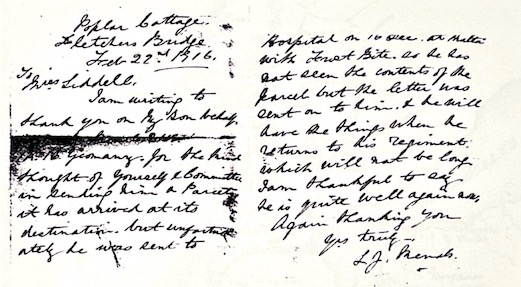
A letter recently on display at the Duke of Cornwall's Light Infantry Museum in Bodmin provides an interesting sidelight to the events at this time. The letter was from Bob's mother, Lizzie Jane Renals, to Miss Liddell of Bodmin, a member of a committee who organised and sent welfare parcels to troops on active service. Bob's parcel arrived at Gallipoli when he was in Malta and although the accompanying letter was forwarded to him he had to wait until he rejoined his regiment before he could receive his parcel.
Bob, like so many others from his regiment, had left Gallipoli before the evacuation had taken place. The remnants of the Devons set sail for the port of Alexandria on the 28th and disembarked there on the last day of 1915. They then marched to Ramleh from where they were transported by trams to Sidi Bish Camp. It is not clear when Bob rejoined the regiment. On 12th February, while at Sidi Bish Camp, the 2nd South Western — the Devon Yeomanry, the North Devons and the West Somersets — and the Highland Mounted Brigade were amalgamated to form a single Brigade of six dismounted regiments.
Images of Gallipoli
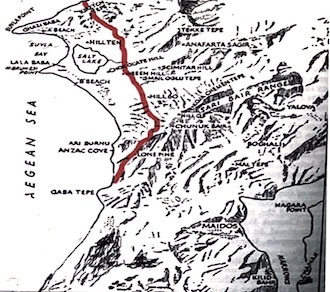
The red line marks the front between the Turkish and Allied troops. This position was established after the August offensive and remained roughly as this until the evacuation. It was the area in which the Devons were involved. The original invasion was at the southern tip of the peninsula.
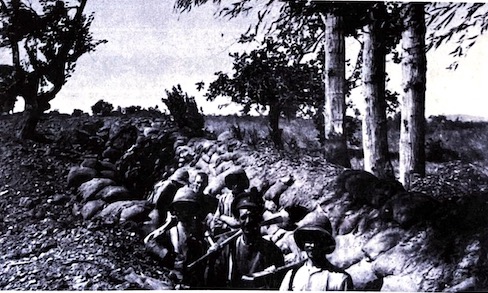
A trench at the foot of Chocolate Hill.
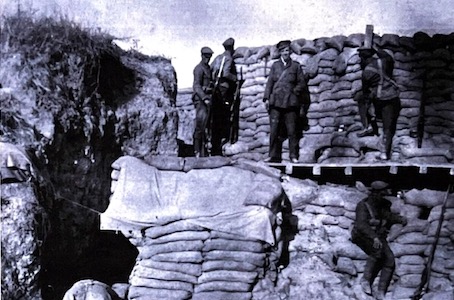
A well established trench. The soldier on the right is observing the Turkish positions through his periscope.
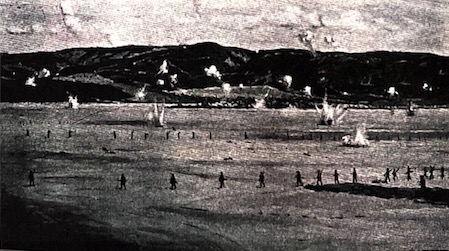
Soldiers crossing the Salt Lake at Suvla. They are spread out to minimise casualties from shell fire.
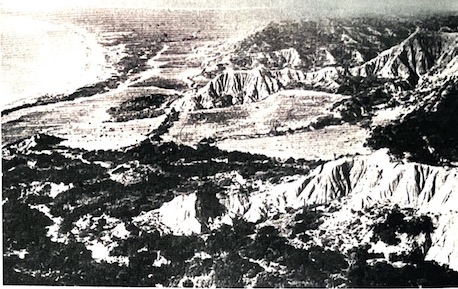
Suvla Plain as seen from the slopes of Sari Bair. In the distance is Salt Lake and on the extreme left is Lala Baba Hill.
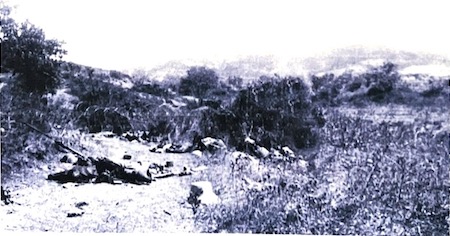
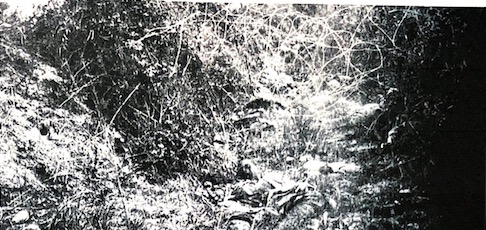
The unburied bodies were a hallmark of the Gallipoli campaign. The above photograph is of a place aptly named "Dead Man's Ditch." The picture below is a close up of the rear of this scene.
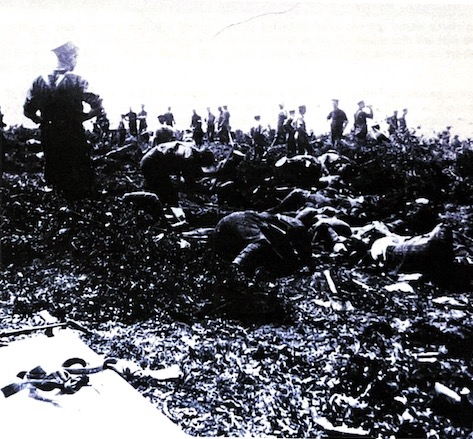
The picture above was taken during a truce called to allow the dead to be buried. Such scenes provide a graphic illustration of the horrors of this war and, indeed, all wars.
[Continues in the Egypt chapter]