World War 1
Essex
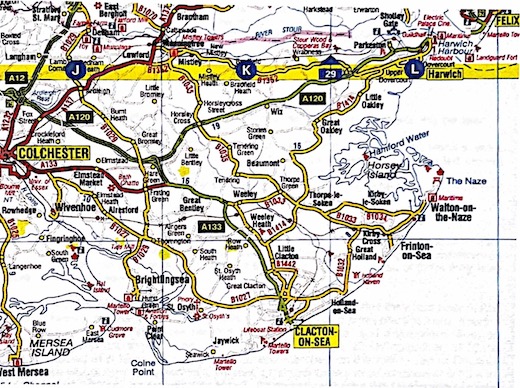
The map above shows the area where the Devon regiments spent the first year of the war. A clearer idea of their location can be had from the orders issued on 17th August following another rumour that the Germans were about to raid the Essex coast.
Keelers' Tye Farm, 17/8/14
Reliable information has been received that a hostile raid may be attempted from the S.E.
(2) The Royal 1st Devon Yeomanry is responsible for the line from Alresford Lodge — Alresford — Elmstead Market, all inclusive. The West Somerset Yeomanry are on our left.
(3) The line will be divided into three sections, and will be occupied by squadrons as follows:
"B" Squadron, O.C. Major Hole. No. 1 Right Section from Alresford Lodge to Alresford, both inclusive.
"A" Squadron, O.C. Major Wyett-Edgell. No. 2 Centre Section from Alresford East, High Elms — Blue Gates — Park Farm, inclusive.
"C" Squadron, O.C. Major Lord Vivian. No. 3 Left Section from Park Farm East — Elmstead Market inclusive.
The outpost lines will be occupied as above every night until further orders.
(4) Alarm
(a) The alarm will only be sounded by orders of the Brigadier.
(b) On the alarm sounding, O.C. Squadrons will act as follows: "A" Squadron will proceed at once to Weeley. The Machine Gun Section and "B" and "C" Squadrons will concentrate at Elmstead Market.
(c) The detached post at the cross roads at Alresford and the post S. of the N. in Wivenhoe will not be withdrawn.
N.B. 1. The precise location of some of the places named in the orders will only be seen on a larger scale map.
2. Immediately after mobilisation the four 1st Devon Yeomanry squadrons were reduced to three. The men of "D" Squadron (Cornish) being the junior were distributed among the three others. This arrangement was not well received by the Cornishmen and fortunately it did not last for long. On 23rd September they were reconstituted under Major Lord Vivian and "B" Squadron was distributed.
Early in September 1915 the War Office invited the regiments of the brigade to volunteer for dismounted service in the Mediterranean. Although they would no longer be cavalrymen there was no hesitation in accepting the offer. If they knew what lay ahead of them they may not have volunteered so willingly.
There now followed a fortnight of frantic activity. The Japanese rifles they had been using for the past twelve months were exchanged for Lee-Enfields and firing practice held. Infantry equipment was issued, horses were handed over to the reserves, and drafts were received bringing each regiment to the full strength of 502 all ranks. On the 22nd September 1915 the Regiment paraded at 8.15 in full marching order and marched on the main road to Clacton-on-Sea station where they entrained for Liverpool. Liverpool Docks were reached at 9.15 a.m. on the 23rd, and 7,000 men embarked on H.M.T. Olympic heading for the Dardanelles to take part in the Gallipoli campaign.
The Olympic was a sister ship of the ill-fated Titanic and was almost identical to her. They were built alongside each other at the Belfast Shipyards, with the Olympic being the first to be launched.
The Gallipoli campaign was initiated to break the deadlock in the muddy trenches of the Western Front by forcing the Dardanelles, capturing Constantinople and knocking Turkey out of the war. Much needed supplies and arms could then be sent to the Russians to help in their desperate struggle along the German front in the Caucasus, and food supplies would once again be able to flow from the Russian Black Sea ports. The campaign lasted from February 19th 1915 to January 9th 1916, during which time the Allied Forces employed 468,987 men, of whom 33,522 were killed, 7,636 missing and 78,420 wounded.
[Continues in the Gallipoli chapter]