World War 1
Egypt
The Ottoman Empire once stretched from the Balkans through Turkey, Syria and Iraq, Palestine, the west and east coasts of the Arabian Peninsula, Egypt and the Mediterranean coastal regions of North Africa. In 1882 civil unrest in Egypt threatened the security of the Suez Canal and led to the British occupation of that country. In 1914 Britain proclaimed Egypt a protectorate.
The defence of the Suez Canal was given high priority and British and Anzac troops evacuated from Gallipoli were sent to Egypt to strengthen the defence capabilities of the Egyptian Expeditionary Force. Palestine, still under Turkish occupation, provided a base for attacks on the Canal whilst in the Western Desert the Senussi tribesmen were threatening the stability of Egypt. The Senussi were Bedouin Arabs who were being exploited by the Turks and Germans to cause concern to the British.
On discharge from hospital Bob rejoined his regiment at Sidi Bish Camp on the coast at Alexandria. A quiet two months were spent here generally recuperating and being issued with new clothing and equipment. Infantry training was undertaken with special attention being paid to night operations. On February 12th, 1916, the 2nd South Western Brigade — the 1st Royal Devon Yeomanry, the Royal North Devons and the West Somersets — and the Highland Mounted Brigades were amalgamated to form a single brigade of six dismounted regiments and became part of the Egyptian Expeditionary Force. Their first assignment was to help protect Egypt's western frontier.
Concern was growing that the Senussi would establish forces on the oases which run through the Libyan Desert in an irregular chain from north to south, parallel with the Nile and from 80 to 140 miles in distance from it. From these bases raids could be carried out on the rich lands of the Nile Valley.
To guard against this the Devons were moved to Minia (El Minya) where they arrived by train on the evening of March 3rd. They pitched camp on the left bank of the Nile. Seven weeks were spent here carrying out camel patrols in the Western Desert. This was Bob's first experience of camels, which he found interesting but stubborn and not to be compared with horses. Gunnery practice was also undertaken as well as route marches which usually finished up by proceeding through the streets of Minia with fixed bayonets. Parties were sent out on an armoured train which patrolled along the railway showing the flag in the riverside towns.
Life was not unpleasant but about the middle of April the yeomen got their first taste of Khamsin weather. The Khamsin is a very dry, strong south or south-easterly wind blowing in off the Sahara Desert with temperatures in excess of 40 degrees centigrade. Prevalent in late spring or early summer, they occur on average three or four times a month and last for up to four days. They are followed by much cooler air blowing from the north. This hot dry wind not only desiccates everything in its path, it also carries large amounts of sand and dust, turning the sun deep orange and creating an eerie feeling. The sandy dust gets everywhere and into everything — food, clothing, bedding, equipment and machinery.
On April 19th the troops left Minia travelling by train southwards to Oasis Junction — half way between Assiout and Assuan — and then by light railway to the Kharga Oasis where they relieved the Shropshire, Cheshire and Glamorganshire Yeomanry.
They camped in a dry river bed. The heat was intense and sandstorms were frequent. Morning parades were dismissed at 8.30 a.m. and from then, until about 4.00 p.m., they did nothing requiring any exertion. Camel patrols were maintained as well as work with Lewis guns, grenades, signalling and telephones. This could have been the time that Bob qualified as a Lewis Gunner 1st Class.
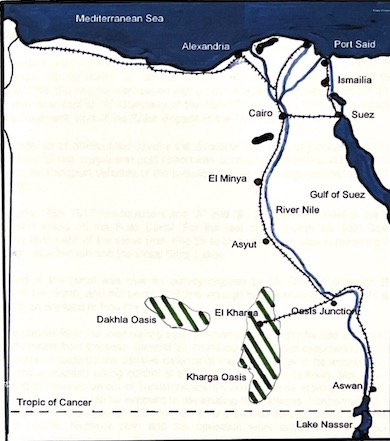
The area where the Devons spent the first twelve months as part of the Egyptian Expeditionary Force.
In the third week of September the North Devons proceeded by rail to Kharga and from there marched to the headquarters of the Kharga force at Sherika. The 1st Devons remained at camp where early in October they were joined by the Ayrshire and Lanarkshire Yeomanries. The object of the concentration was to cross the eighty miles of desert from Kharga to Dakhla Oasis and drive out the Senussi force controlling that oasis. Whether it was the capture of Silva which coincided with the approach of a light car patrol, or intelligence regarding the build up of British forces, the Senussi — believing that discretion was the better part of valour — decided to leave the area. With the threat now removed the outlying squadrons were recalled and the North Devons rejoined the 1st over the 8th—10th November. Three weeks later the whole of the 2nd Dismounted Brigade concentrated at Moascar Camp, Ismailia and were attached to the 53rd Division.
On December 26th, 1916 orders were received that the Royal 1st Devon Yeomanry was, with the Royal North Devon Hussars, to form the 16th (Royal Devon Yeomanry) Battalion of the Devonshire Regiment. With the other four regiments of the 2nd Dismounted Brigade a four battalion brigade was formed numbered the 229th and was part of the 74th (Yeomanry) Division. Bob's old squadron "D" of the 1st with two troops of "A" Squadron formed "A" Company and like the rest he was issued with a new regimental number — 345079. The Cornish squadron was now part of "A" Company of the 16th (Royal Devon Yeomanry) Battalion of the Devonshire Regiment, part of the 229th Brigade of the 74th Division.
Being made up of dismounted cavalry the divisional sign was, appropriately, a broken spur and later a flash of red, purple and gold ribbon was adopted as the battalion badge and worn on the shoulder. All transport vehicles of the battalion carried the badge painted above the sign of the broken spur.
On January 16th, 1917 headquarters and "A" and "B" Companies moved to the Ferry Post and El Ferdan areas on the Suez Canal. For the rest of the month the 16th Devons were patrolling the east bank of the canal from Kilo 58 to Derversoir and also supervising the fishing by natives of Lake Timsah and the Great Bitter Lakes.
Swimming in the canal was now an activity enjoyed by all. On one occasion Bob found himself out of his depth and, not being confident enough to turn around, swam right across the canal, turning on dry land to face the swim back.
With the danger from the west having been overcome the British now had to consider how to deal with the threat from the east. General Sir Archibald Murray, who assumed full control of the Egyptian forces, considered the passive defence of the Suez Canal to be wasteful of men and resources and advocated taking control of the coastal area up to El Arish. Not only would the principal road of invasion be out of Turkish hands — any hostile forces seeking to attack by taking a more southerly route would be exposed to devastating flank attacks. Furthermore, allied forces would be in a more favourable position to react to any Turkish concentrations in Palestine. The War Office backed Murray's plan and the operation went ahead and was successfully completed when, after a fierce battle, El Arish was captured on the 23rd December, 1916. The advent of David Lloyd George to the premiership provided added impetus to this theatre of war. Although of no strategic importance, Lloyd George felt that the capture of Jerusalem would undermine the morale of the Turks and boost the spirits of this country and the Empire. The decision was made to advance into Palestine.
Patrolling continued for a month and on March 3rd helmets were issued, the next day they marched to Kantara, and on the 6th moved to El Arish by rail. They were the first unit of the 74th Division to reach that place and their first task was to dig a deep trench around their camp, mainly for air raid precautions. Enemy aircraft flew over the camp on a daily basis, albeit at a great height.
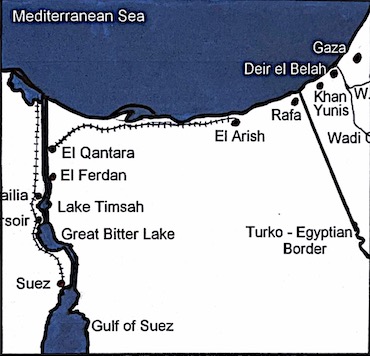
More than a fortnight was spent at El Arish but on 21st March the march to the front began and tents were left behind. The battalion marched to El Burg where it bivouacked — camped in the open without tents — until the 24th. The march was resumed to Sheik Zowald and then to Rafa on the 25th. The last two miles into Rafa were without the 'wire' road and marching ankle deep in sand with full kit was an arduous task. At Rafa an outpost was taken up and defensive trenches dug.
The first battle of Gaza began on March 26th but failed. The Devon Yeomanry, twenty miles away at Rafa, took no part in the action. They remained at Rafa while preparations were being made to renew the attack on Gaza and then moved on to Khan Yunis on April 5th, Deir el Belah on the 6th and In Seriat the following day. Here they relieved the 54th Division in the outpost line near the junction of the Wadi Sheria and the Wadi Ghuzze and spent the following week entrenching.
Again the Devon Yeomanry took no part in the second battle of Gaza on the 16th April, which also ended in failure. During the 17th and 18th the battalion was under orders to move at a moment's notice. The move was made on the 19th when the battalion marched to Mansurah Ridge. At noon on the following day they marched south east past Tel el Ahmer, bivouacking in a wadi for the night before proceeding the next day to El Mendur. Here they took part in the construction of a defensive line from Tel el Jemmi on the Wadi Ghuzze to the Apex, the right portion of this line being assigned to the 16th.
Conditions at this time were not good. Sickness was prevalent, doubtless due to the swarms of flies. Men were infested with lice and scorpions were a menace. An important part of their routine to combat the latter was to upend boots before putting a foot inside. Water was scarce and for two days a sandstorm brought on by the Khamsin added to their miserable existence. On the 17th May the battalion was relieved and moved to Wadi Nukkabeer and then, on the 18th May, to Sheik Abbus taking over the Apex portion of the front line trenches.
The Turkish defences opposite the Yeomanry division were two to three thousand yards distant which created an extensive area of no man's land. Each evening at dusk two patrols were despatched to survey the area. Often skirmishes took place with Turkish troops, resulting in casualties and losses on both sides. On one occasion, when Bob was on patrol, he spotted a Turkish soldier who had left his post to answer the call of nature. Bob waited until he had dropped his trousers and exposed his bare buttocks, then took aim and fired. The Turk did not stay to complete formalities and Bob did not hang around either.
On June 15th the battalion was relieved and went into reserve until the 28th when it took over the left sector of the brigade line until July 9th. They then marched to the Wadi Laban rejoining the remainder of the brigade. Two months were now spent in training for the great advance towards Jerusalem which was now being planned. From August 26th to September 5th the battalion bivouacked at Regent's Park and took part by night in trench digging.
Regent's Park was the best camp the Yeomen had in Palestine. It was right on the coast and everyone took advantage of the position. When off duty most of the time was spent in the sea along with officers' horses and transport mules. Scarcity of water was a serious problem in this theatre of war and had to be a major consideration in strategic planning. The failure of the first battle of Gaza was in no small part due to a shortage of water. It was not uncommon for orders to be issued prohibiting the use of water for all cleansing and washing purposes, so it was not surprising that the sea adjoining Regent's Park was such a popular amenity. It also provided a remedy for the septic sores which were very prevalent, ensuring the physical and mental wellbeing of the troops improved considerably.
From Regent's Park the Yeomen moved to a new bivouac at Gaz el Taire about one mile east of Deir el Belah Station. Here they were engaged in a period of strenuous training involving night operations, marching on compass bearings, taking up a line of outposts or deploying for an attack.
The third battle of Gaza was about to begin and the first stage of this attack was to be the capture of the strategically important town of Beersheba, which also had a valuable supply of water. The 74th and 60th Divisions were to attack the Beersheba defences. On the night of October 25th the battalion marched to Abbu Sita and the following night to Gamli where they arrived at 3.00 a.m. on the 27th. News was received at 2.00 p.m. that the cavalry outposts had been heavily attacked so the 229th Brigade was ordered to march to El Buggar at once, which meant a march through very heavy sand on a blazing hot afternoon. The attack on Beersheba was scheduled for dawn on 31st October and the 229th Brigade was given the task of crossing the Wadi Saba and taking up an outpost line on the far side to provide cover for the crossing of the remainder of the division and the two attacking brigades. This having been accomplished the outpost lines were called in and bivouacked in readiness to move instantly.
On the 31st, from a ridge above their bivouac the Devon Yeomen had a good view of the Turkish positions and the two brigades advancing to attack. However, as battle was joined the dust raised by the exploding shells obliterated the scene. The attack was successful and the Turkish positions were captured.
Early next morning, without breakfast because the water had not arrived, the battalion marched off to a bivouac on the north side of the Gaza—Beersheba road close to the trenches captured the previous day. At noon on the following day they moved to the Wadi Irgeig and set up an outpost line. A Khamsin blew all day making the shortage of water a serious problem. A Divisional Order was issued forbidding anyone to wash or shave. The battalion remained at Wadi Irgeig for twenty-four hours before moving off to new outposts in the vicinity of Muweileh.
Preparations were underway for an attack on the centre of the Turkish defences at Tel el Sheria, almost twenty miles north-west of Beersheba. These defences, some two miles in extent, were well sited and consisted of a series of strong redoubts facing south on the right bank of the Wadi Samara. Their trenches were well constructed, deep, effectively concealed and fully equipped with heavy rifles, machine guns and artillery. To reach these positions the 229th Brigade had to cross 4,000 yards of open countryside consisting of rolling downs of sun-baked clay and completely without cover except for the occasional shallow wadi.
The Brigade concentrated at 10.00 p.m. on November 5th to take up position for the attack which opened in the half light at 5.00 a.m. the next morning. Little preparation had been done by the artillery and there was a great deal of enfilade fire which caused casualties in the early stages of the attack. The success of the ensuing battle was in no small way due to the remarkable speed with which the battalions of the 74th Division advanced. They were described as going off "like a pack of hounds" — pressing forward with great determination regardless of the heavy fire from in front and on their right. The Turks were well protected and fought bravely, offering stubborn resistance. In spite of the stout defence, by 9.00 a.m. the 229th Brigade had overcome the enemy positions and secured its objective.
Immediately the Brigade was reorganised for a fresh attack on their left against the Turkish positions nearer the railway and south of Sheria. This second attack coincided with the 60th Division's assault on the Kauwuka defences. Again a rapid advance and excellent covering fire from the divisional gunners resulted in the whole objective being secured by 4.00 p.m.
Considering the heavy fire to which the battalion had been exposed the casualties were surprisingly light. Five men had been killed, among them their commander, Col. Thynne, and thirty-seven wounded.
During the operation some of the Devon Yeomen had got involved with the 230th Brigade and were engaged in the fighting near the Wadi Union. They came to the help of a company of the Sussex Yeomanry who had been counter attacked and driven from a battery of Turkish guns which they had just captured. The enemy soldiers were in the process of hitching teams of oxen to pull away the recaptured guns when a platoon of the Sussex and another of the Devon Yeomanry rushed the high ground, charged the Turks and reclaimed the guns. This time a position beyond the guns was immediately occupied and further counter attacks beaten off.
Before evacuating Sheria Station the Turks set fire to a large ammunition dump. The fire and explosions which followed lit up the whole countryside and the planned advance was prevented. However at 3.30 a.m. the next morning, 7th November, the advance was continued and Tel el Sheria fell about an hour later. A line was established north of the town and that night the Devons bivouacked at a location about five miles north of Irgeig.
At dawn on the 7th the 10th Division stormed and captured the Hareria Redoubt and, with Sheria already in the hands of the British, the Turkish left was definitively broken. The vital water supply was now in the possession of the British and the way was open for the cavalry to go forward and harry the retreating enemy.
The Turkish defences at Gaza were now outflanked and, fearing for their lines of communication, they evacuated the town and retreated northwards. Gaza was occupied on the 8th November.
[Continues in the Palestine, Beersheba and El Foka chapter]