World War 1
Destination — The Somme
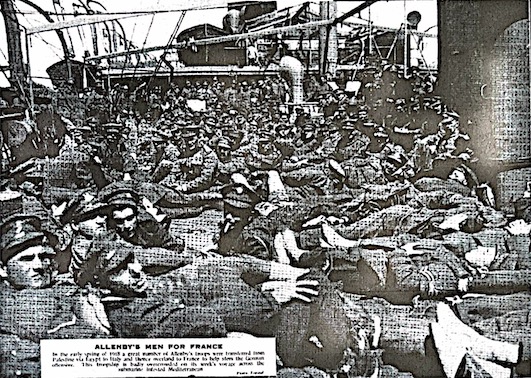
The photograph above was originally published in a magazine. The caption reads:
"Allenby's Men for France — In the early spring of 1918 a great number of Allenby's troops were transferred from Palestine via Egypt to Italy and thence over land to France to help stem the German offensive. This troopship is badly overcrowded on its week's voyage across the submarine infested Mediterranean."
This report is at variance with official accounts of this event. In The Bloody Eleventh, the history of the Devonshire Regiment, Volume III, the author W.J.P. Agett states: "On 4th April orders were received for the transfer of the 74th Division to the Western Front: by the 9th April, the 16th Battalion was in the divisional concentration area at Ludd and, on 1st May, after picking up reinforcements of 102 men and four officers, it embarked in HMT Leasowe Castle to reach Marseilles six days later."
The Leasowe Castle therefore arrived at Marseilles on May 7th, 1918 — Bob's 25th birthday. Three days previously would not have been a great celebration but few of his relations and friends back home would have spent such a day cruising the Mediterranean.
After one night at the Base Camp at Marseilles, the Devon Yeomanry Battalion, now up to establishment of 800 plus, entrained for Noyelles which was reached on May 11th. The three day journey through France provided scenes of great contrast to the Eastern theatres where they had lived and fought for the past two years. It was early summer in France and the lush countryside of green fields, trees and hedges gladdened the hearts of the west country troops. The scenery was not the only thing that raised their spirits. They were now able, for the first time for over two years, to obtain a fair allowance of leave for England. Water was in plentiful supply and could be used without limit or restrictions. Their clothing had been cleared of lice and was now warm, dry and comfortable. Indeed soldiers living in the back areas of France enjoyed considerable comfort.
It was probably at this time that Bob and others were billeted in a fine country mansion. The feeling grew among the troops that the quality of food being provided was not in keeping with their opulent surroundings. Bob, who from his early teenage years enjoyed the sports of shooting and fishing, took his rifle and set off into the countryside. Many times had he set out like this in the fields and woods around Fletchers Bridge, albeit carrying a 12 bore gun rather than a rifle. It would be a rare thing to return without a rabbit, pheasant, pigeon, snipe or woodcock. Not long after his departure a shot was heard and a little later Bob returned with a pig. He had learnt the art of butchery from his grandfather and father who combined this with their farming and forestry business. It did not take long therefore to shave, gut and cut the animal into its various joints. For a short while at least they lived in a style which a few weeks previously would have been beyond their wildest dreams.
The part of France where the Devons were deployed is shown in the map below. They were involved in four areas marked on the map by coloured ovals. For most of their first three months there they underwent training for the type of warfare they would be facing on the Western Front. Lectures, demonstrations and practice in bayonet fighting were mostly a waste of time as the Devons had had ample experience of this type of warfare in Palestine, probably more than their instructors. However fighting with tanks and aircraft was new to them as was the use of gas masks.
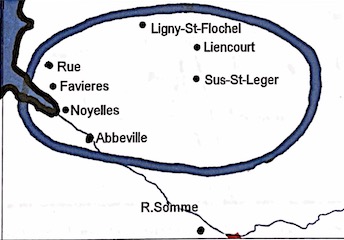
After arriving at Noyelles the battalion marched to Favieres near the mouth of the river Somme. On 20th May they entrained at Rue and arrived at Ligney-St-Flochel the next day. A long march to Sus-St-Leger followed and on the 25th they marched to Liencourt where intensive training took place. Towards the end of June they set off by train for Aire from where they marched to the Foret de Nieppe where they bivouacked until July 10th. Here they were employed on improving defences. From there they moved to Guarbeque. The Devons became part of the reserve brigade of the 74th Division which had relieved the 61st Division in the line.
N.E. France and Belgium
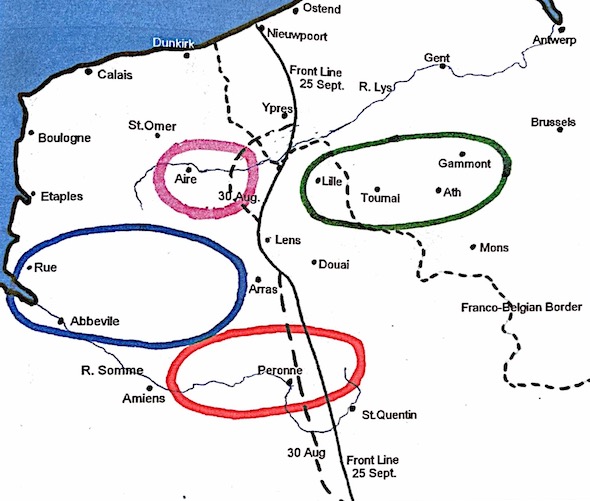
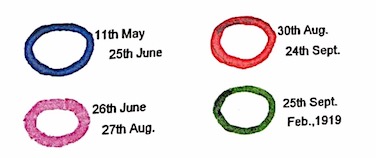
During their time in France the Division served in the four areas shown above by the coloured ovals. Below is shown the period spent in each area.
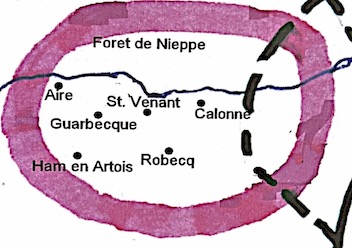
On the night of July 23rd the Devon Yeomen moved up to the front line taking over part of the Amusoires—Haverskerque line between Robecq and St. Venant. Once again the 16th Devons were in contact with the enemy but in country vastly different from their last battlefields in the Judean hills. The flat marshy meadows through which the river Lys meandered had been spared the ravages of war except for the German push in April. Trench digging was as difficult here as it was on the stony ridges near Tel Azur but for a different reason. The line was held by breastworks which consisted of disconnected posts in the midst of growing crops. There was however ample cover from the trees, hedges and undamaged buildings.
On their first night in the line they were attacked by a sizeable German force which was somewhat taken aback by the ferocity of the resistance. The enemy, having suffered over 20 casualties, retired discomfited and chose not to repeat the exercise. Shortly after this, reports came through from the division further to their right that the German trenches opposite them were empty. Patrols at once pushed out. The 230th Brigade on the left found the Germans in force but the Devons and the Fife and Forfars entered the German lines and found that they were indeed empty. The Devons pressed on following the retiring enemy, capturing a machine gun and taking one prisoner. For two days over a distance of about two miles they cautiously pursued the slowly retiring Germans. Once over the river Lys the Germans stood their ground. The withdrawal had not been part of a general retreat but a local retirement enabling the Germans to straighten and shorten their line. A few days later however the enemy retired further and when the 16th Devons returned from a week's training at Ham en Artois they had a long journey to the front line over the Lys and to just east of Calonne. The Devons were relieved on 27th August and returned by bus to Ham en Artois. Two days later they entrained at Berguette for the Somme.
The Devons were now heading for a region which had seen some of the bloodiest fighting of the war. It was here on the 1st July 1916 that the main attack on the Western Front during that year was launched. It was planned as a battle of attrition with the aim of draining the German forces of reserves, although territorial gain was a secondary aim. The battle was brought to an end on 18th November by heavy snow. On the first day 58,000 British troops were lost — one third of them killed. To this day it remains a grim record for the heaviest losses in one day. At the end the Allies had gained 12 kilometres of ground; the British casualties were estimated at 420,000, the French 200,000 and the Germans 500,000. Among the British casualties were many of the volunteer 'pals' battalions.
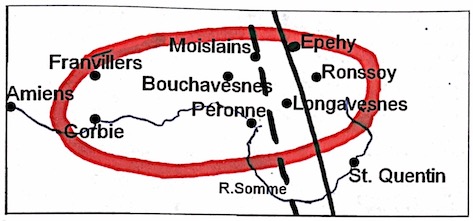
The Devons detrained at Corbie on 30th August and marched to Franvillers. They were then bussed to the countryside around the recently captured village of Bouchavesnes from where they were immediately despatched to the line north of Peronne.
The Brigade relieved the 58th London Division at 11 p.m. on 1st September taking over the trenches east of Bouchavesnes. They were to attack at 5.30 a.m. the following morning. The plan assumed that Moislains was unoccupied. The North Somersets, leading the attack, were to by-pass Moislains leaving the village to be cleared by "A" and "B" Companies of the 16th Devons. This was expected to be a formality after which they would follow the Fife and Forfars into the front line.
The Devons had had no time to reconnoitre the area and the assumption that Moislains had been evacuated proved wildly inaccurate as the Germans were there in force. Furthermore they held advanced entrenched positions south west of the village. The West Somersets in clearing these trenches fell behind the barrage being laid down to clear their way. The Fife and Forfars were enfiladed from Moislains and suffered severe casualties. When "A" and "B" Companies approached Moislains they met very strong opposition and lost heavily from machine-gun fire. They could do no more than reach the outskirts of the village. Meanwhile the leading battalions had come under attack from the elite Alpine Corps and were pushed back over the Canal du Nord to a line 300 yards west of the village. Here they rallied and held their positions. To this line "A" and "B" Companies also retreated. That night "D" Company relieved them and managed to hold the position the next day in face of heavy fire and much gas shelling.
On the 4th it was discovered that Moislains had been evacuated. Immediately patrols pushed out and by evening, in the face of fierce fighting, the line had crossed the canal and was established on the slope beyond. Casualties were quickly mounting and now totalled 200 since the 1st September.
Bob could have been among the casualties as at some stage in the battles he was gassed. It is not known how severely he was injured but the damage affected him from time to time, albeit not seriously, for the rest of his life.
On the night of 4th September the 229th Brigade was relieved and the next two days the other brigades pushed on past Longavesnes to the outskirts of the Hindenburg Line level with Epehy. Here the Germans were making a stand and the British advance was brought to a halt. Five days later they moved forward again. By now the British forces were achieving success all along the front and the decision was made to break through the Hindenburg Line. But before this could be achieved the outworks would have to be cleared.
The 229th Brigade was called upon to tackle the horseshoe trench system in front of Ronssoy and at the same time the 58th Division was to attack Epehy. The 16th Devons with the Fife and Forfars were leading the attack. Although meeting stout resistance both battalions succeeded in entering the enemy's trenches and established a precarious foothold on the ridge. The key task of the operation was, however, not achieved when the 58th failed to capture Epehy. This further weakened the Devons' position and in the face of a vigorous counter attack the Yeomen were driven from the ridge and forced to retire to their starting positions. That night they were relieved by the 230th Brigade and spent the next week in reserve in billets in the neighbourhood of Longavesnes.
On 17th September the battalion, attached to the 231st Brigade, moved forward again in preparation for a major attack on the following day. Both the Third and the Fifth Armies were involved in the offensive along a seventeen mile front. The 74th Division was part of the force attacking Epehy and the 16th Devons were very much involved in the action. The objective of the 231st Brigade lay east and north-east of Ronssoy. The Devons were attacking on the right of this and took their objectives with considerable dash, capturing many prisoners, several guns and a considerable number of machine guns without heavy loss to themselves. The second objective proved more difficult and the attacking units were held up by stubborn opposition. A second effort was made early in the afternoon which finally overcame the opposition and secured a major part of their second objective.
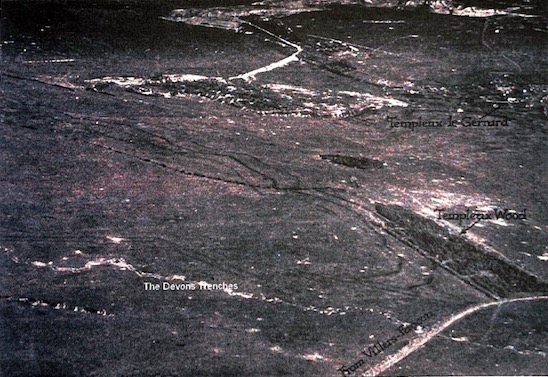
The trenches held by the Devon Yeomanry on the 16th September prior to the attack on the Hindenburg Line.
Three days later the Division set out to achieve the third objective. This time the 16th Battalion was held in reserve and was fortunate to escape the heavy casualties which the attacking battalions incurred. These battalions reached their objectives but were counter attacked with such force that they were driven back to the original front.
On 23rd September the 229th Brigade took over and for two days the Devons were in the front line east and south of Ronssoy. Patrols were pushed forward another 250 yards to secure a better starting position for the next attack. However, plans were changed and the attack did not take place. On the night of 24th September the 74th Division was relieved by American forces and entrained for the Villers Bretonneux area and thence to the Lys Valley and the 5th Army's area.
In this period of fighting in the Somme area the 74th Division had had over 3,500 casualties. For the 16th Battalion the second spell of fighting cost another 100 casualties. The Division had been confronted by a determined enemy and a difficult task. Although it had not finally secured all its objectives the Division had played an important part in pushing the Germans back into the Hindenburg Line and by its good work on 18th September contributed much to the capture of Epehy.
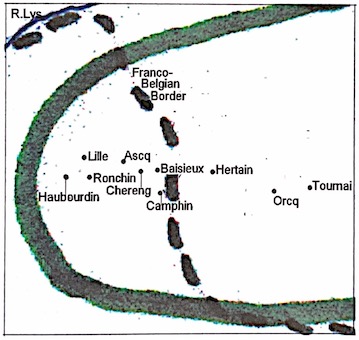
The 16th Devons took no part in the advance being made by the 230th Brigade. They were involved in trench digging during the early part of October but on the 15th moved forward to support the advance of the 74th Division. With the Fife and Forfars the enemy lines in front of Haubourdin were attacked and the Germans forced to retreat. In this action the Devons did not have to fire a shot. The enemy fell back to Haubourdin and regrouped to defend the village. They kept up a constant barrage of artillery and machine-gun fire. The artillery bombardment lasted until midnight but the machine-gun fire continued until 4.30 a.m. Later that day, the 17th, patrols reported that there was no sign of enemy forces in Haubourdin. The Devons along with the Fife and Forfars moved forward and entered the village. Progress was not easy as the Germans had blown up culverts and bridges, left gaping craters on crossroads and set up barbed wire entanglements and booby traps.
When confirmation of the evacuation of Lille was obtained a pontoon was thrown across the canal enabling guns and weapons to pass over to continue the advance to Ronchin where the Devons spent the night. The next day they continued the advance. On approaching Ascq they met strong resistance from the enemy located behind a railway embankment. Equipped with machine guns the Germans were in a strong position but at 1.00 p.m. when "C" and "D" Companies with "A" and "B" in support attacked, they retreated across the river without putting up much of a fight. The Germans were now well placed to make a determined stand but with British battalions advancing steadily on both flanks they would soon be in danger of being cut off. Patrols were out all that night but no contact with the enemy was made.
On the 19th patrols confirmed that Chereng was clear of Germans so the Yeomanry pushed on past the village and eventually reached the Camphin—Baisieux line close to the Franco-Belgian border. During the advance "A" Company was checked for a while east of Chereng by the enemy who was holding the high ground. The Devons pressed their attack and the Germans quickly withdrew, retreating to Orcq. Here a determined stand was made which brought the 74th Division's advance to a halt.
Having been relieved by the 231st Brigade the 229th went into billets at Baisieux on 24th October. Unfortunately this area was still in reach of the long range German guns and the troops were pounded by shell fire resulting in one soldier being killed and seven wounded. Tragic though it was, these were their last casualties. To escape the shelling the battalion was moved back on 4th November to excellent billets in a weaving mill at Chereng where they remained until 9th November when they set off across the Belgian border and headed for Hertain. From Hertain they continued their march the next day through Tournai to Thimouges.
They received an exuberant welcome from the population of Tournai. Their welcome became even more enthusiastic when the battalion band played La Brabançonne during the usual hourly five-minute rest halt. This was the first time the Belgians had heard their National Anthem since the Germans had entered the town in 1914.
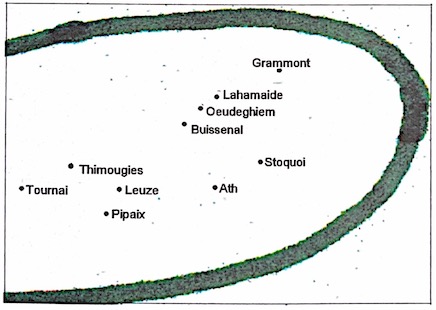
The following day, 11th November, during the mid-day halt on the road from Thimouges to Lahamaide, news of the Armistice was received. Orders were issued that units, as far as possible, should billet in the immediate area they happened to be in when the news arrived. Unfortunately for the Devons no billets were available so the march to Lahamaide was continued.
Orders were received to proceed from Lahamaide to billets at Stoquoi. On arrival outposts were to be set up and military precautions observed. They stayed here until 17th November employed in repairing the extensive damage done to the railways by the retreating Germans. Preparations were also in hand for the march to Cologne but the 74th Division did not take part in this. One afternoon was given over to sports. From Stoquoi the Division marched to Buissenal and then to Pipaix. Here educational courses were run and sporting activities enjoyed including an inter-platoon football competition. Assistance was given to the local farmers in transporting their crops of sugar beet. On the 7th December the Division was drawn up on the Leuze-Tournai road to be presented to King George V who, with the Prince of Wales and Prince Albert, was visiting the British Armies in Belgium.
The Battalion moved to Oeudeghien on the 19th December and the following day arrived at Grammont — now called Geraardsbergen. Preparations for demobilisation were now in full swing including further courses of general education. Over the next few months the 16th Battalion The Devonshire Regiment was disbanded. In February demobilisation started when nearly 150 men left for England. Bob was demobilised on 4th March, 1919 and would have been among these. For some the triumphant return home was not to be as the train carrying them to their embarkation port crashed, resulting in the death of a number of men. In March 107 men and in April 60 men were drafted to the 2/4th Oxford and Bucks Regiment destined for the army of occupation in Egypt. Men who had previously served in Egypt were not included in these drafts. In June 1919 the Battalion, now reduced to cadre strength, returned to Exeter and so brought to an end the 16th (Royal Devon Yeomanry) Battalion The Devonshire Regiment.
[Continues in the Acknowledgements]