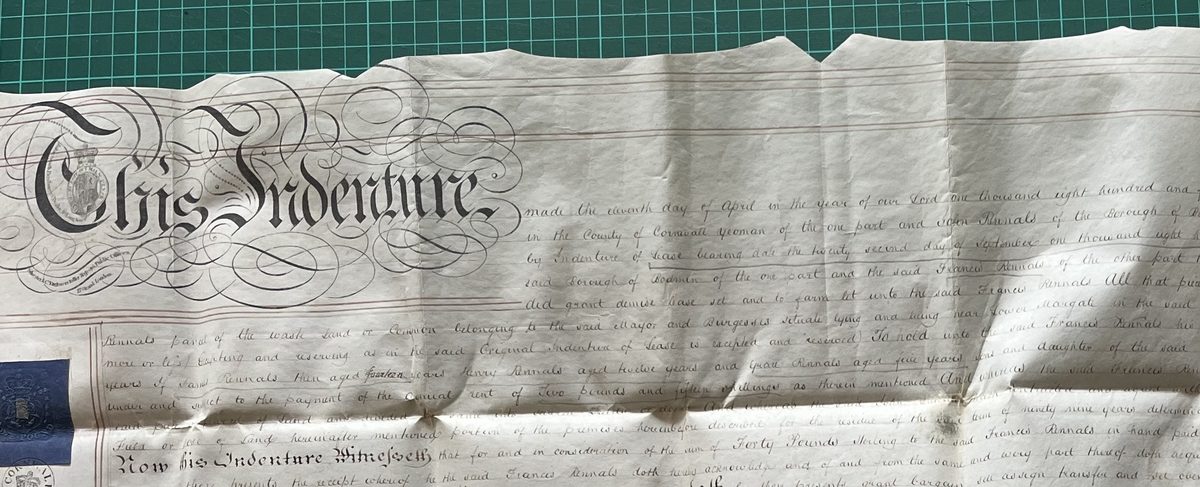
 Legal deed of assignment, 11 April 1840 — Francis Rennals to his son John Rennals, transferring the North Park close near Lower Margate
John Rennals (1814–1894) — Blacksmith at Margate
John does not appear to be a direct ancestor in this line, but the documentary record shows he took on significant financial risk over several years, using his siblings' lives as security for loans against a parcel of land — decisions which shaped the family's later property dealings around Bodmin.
John was the son of Francis Rennals (b. c.1781) and Sarah "Sally" (née Jory), and brother to James (b. c.1818), Henry (b. c.1821) and Grace (b. c.1827, christened Sept 1827, Cardinham), among others. He worked as a blacksmith at Margate — one of several named farms, fields and holdings, alongside Turf Down and Poplars, within the wider Fletchers Bridge area of Bodmin. The forge building he worked survives to this day, modified, alongside the former cobbler's shop.
The land: North Park, near Lower Margate, Bodmin
The underlying property was originally leased by the Mayor and Burgesses of Bodmin to Francis Rennals on 22 September 1832, for a term of 99 years determinable on the lives of three of his children — James, Henry and Grace Rennals — a common leasehold structure of the period, in which the lease's duration was tied to the survival of named individuals rather than a fixed term.
1840 — Assignment from Francis to John
By an indenture dated 11 April 1840, Francis Rennals assigned the North Park close (three acres, near Lower Margate) to his son John, described in the deed as "of the Borough of Bodmin, Blacksmith" — his trade in fact being carried on at Margate, where the forge building he worked still stands today, alongside the former cobbler's shop, both modified over the years.
1841 — First mortgage to Henry Mudge
By an indenture of mortgage dated 24 April 1841, John Rennals mortgaged the North Park close to Henry Mudge, surgeon of Bodmin, in consideration of £50 lent and paid.
A note on "close": Legal documents of this period often describe land as a "field or close," a doubled-up phrase conveyancers used as a matter of habit, to guard against any dispute over terminology. In this instance, though, "close" is the more precise term. A close, in the strict sense, was land enclosed — hedged or fenced off — out of former common or open land, marking its shift from shared to individual ownership. North Park was exactly this: the 1832 lease itself describes the land as part of "the Wash Land or Common belonging to the said Mayor and Burgesses... then intended to be enclosed." What the documents record, in other words, is not simply a parcel of farmland changing hands, but a small piece of Bodmin's common land being carved out, hedged, and brought into the family's use for the first time — the very moment North Park became a "close" in fact as well as in name.
1846 — Life insurance on Grace Rennals
By an instrument or policy of insurance dated 5 November 1846, John Rennals effected an insurance upon the life of his sister Grace Rennals — one of the three lives named in the original 1832 lease — with the Temperance Provident Institution, London (policy no. 2588), in the sum of £100. This insurance was taken out specifically to protect the security of the leasehold and the loan against it, since the lease itself, and therefore John's mortgaged interest in the land, would fail if any of the three named lives ended.
1847 — Further mortgage to Henry Mudge
By a further indenture dated 11 December 1847, John Rennals borrowed an additional £50 from Henry Mudge, bringing the total secured against the property to £100, at 5% per annum, with the Grace Rennals life policy pledged as additional security alongside the land itself.
Sources: 1841 mortgage, 1847 further mortgage, and 1840 assignment — original documents, photographed by Andy Renals, 2 August 2026, using an iPhone 13. Private collection (Kevin and Angela Renals bundle, 1840–1929).
1859 — Assignment of the Smith's Shop, Margate, to William Seccombe
By this date John Rennals was living at Branstone, in the Parish of St Winnow, styled Yeoman rather than blacksmith — a shift in occupation, or at least in how he was formally described, from the trade recorded in the 1840s documents above.
By an indenture dated 7 June 1859, Sally Renals of Margate, widow of Francis Renals, and John Renals of Branstone, St Winnow, Yeoman, assigned to William Seccombe, blacksmith of Margate, the Blacksmith's Shop and Shoeing House with its courtlage, for £20.
The document recites, for the first time in the family's surviving papers, the date of Francis Rennals's last will and testament: 1 April 1857. By that will, Francis left the Smith's Shop, Shoeing House and a field called the "Tiny Field" (about one acre) to his son John, subject to John paying Francis's daughter — Grace Pascoe — one pound yearly during her life. This is the first record of Grace's married surname; she does not appear to have been previously known by this name elsewhere in the family's documents. Sally was named sole executrix of the will, with the right to enjoy the whole of the property during her own lifetime.
Sally signed by her mark, being unable to write; John signed his own name. The document was witnessed by Henry R. Bray and Nicholas Ellery, with two red wax seals affixed.
Source: original document ("Assignment of Smith's Shop &c. at Margate"), photographed by Andy Renals, 4 August 2026, using an iPhone 13. Private collection (Kevin and Angela Renals bundle, 1840–1929).
A note on the surname: John appears in these documents consistently as "Rennals," while a later document (1859) names him as "Renals" — see A Note on the Spelling of Renals for what the surviving records show.