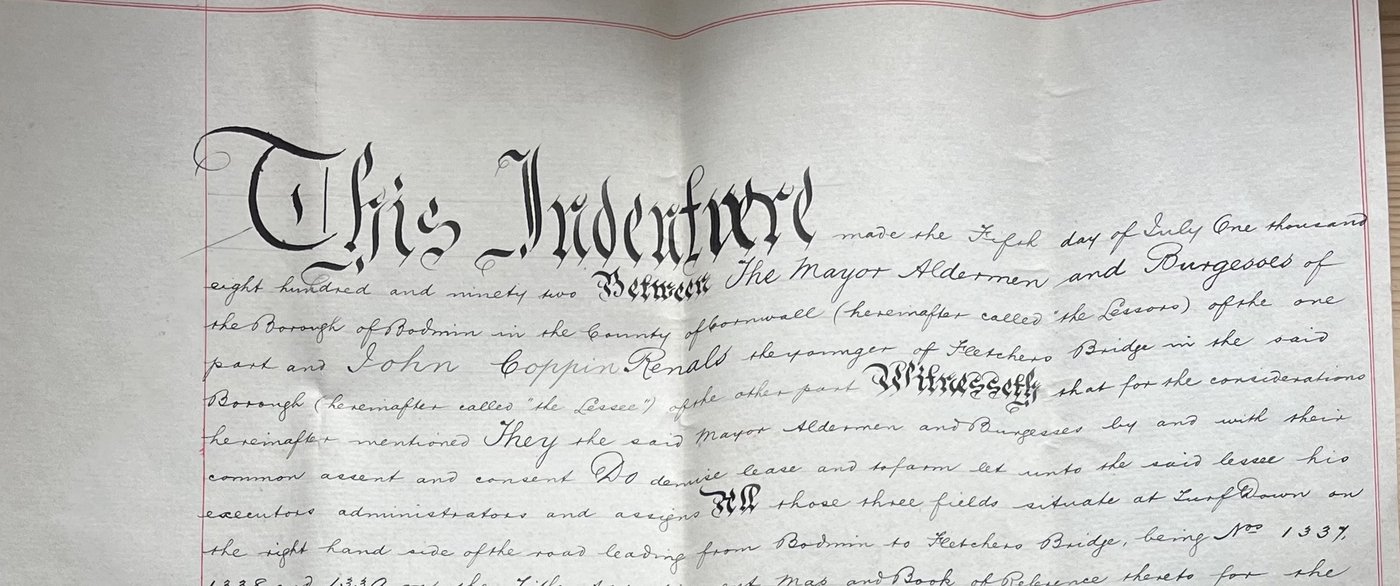
 Opening of the 1892 lease, the earliest so far found for John Coppin Renals, naming him "the younger, of Fletchers Bridge"
John Coppin Renals (1859–1931) — "Butcher John"
Known within the family as "Butcher John" — a nickname recalled by his great-grandson Kevin Renals at a family meeting on 1 August 2026, and independently confirmed by the 1895 lease shown above, in which John is formally styled "Butcher" of the Borough of Bodmin.
Born in 1859 in Bodmin, John was the son of James Renals and Rebecca Coppin, and married Elizabeth Jane "Lizzie" Hoskin in 1890. He died on 27 December 1931 at Fletchers Bridge, Bodmin. He is recorded as a butcher in the 1891 and 1901 censuses, and by the 1911 census as a farmer at Poplar Cottage, Fletchers Bridge — a working life that in fact encompassed trade and land management together: farmer, woodsman, butcher and supplier.
1892 — Original lease of Turf Down (No. 125a)
By a lease dated 5 July 1892 (No. 125a), the Mayor, Aldermen and Burgesses of Bodmin let to John Coppin Renals the younger, of Fletchers Bridge, three fields at Turf Down — numbered 1337, 1338 and 1339 on the Tithe Apportionment Map, containing nine acres and seven poles, situated on the right-hand side of the road leading from Bodmin to Fletchers Bridge. The land was lately in the occupation of a Mr John Mudge — a name that recalls Henry Mudge, surgeon, the mortgagee in John Rennals the blacksmith's 1841 and 1847 dealings, though no confirmed family connection between the two Mudges has yet been established.
The term was 14 years from 25 March 1892, at a yearly rent of £13 2s 6d, with an additional rent of £20 per acre for any land misused contrary to the husbandry covenants. This is the same rent figure recorded in the 1907 lease below, confirming that 1907 was in substance a renewal of this same holding, even though the 1907 document itself does not explicitly describe itself as one.
The styling "John Coppin Renals the younger" is notable, and not repeated in any later document in the collection. It may simply distinguish a young tenant taking on his first significant lease, or it may hint at another "John Coppin Renals" or "John Renals" senior active at the time — this has not been resolved and is worth further research.
The lease was sealed at a meeting of the Council at the Guildhall, Bodmin, on 5 July 1892, signed by Augustus Coombe Sandoe, Mayor, and witnessed by R. P. Edyvean, Town Clerk.
Source: original document ("No. 125a"), photographed by Andy Renals, 3 August 2026, using an iPhone 13. Private collection (Kevin and Angela Renals bundle, 1840–1929).
1895 — Reversionary lease, substituting a new life
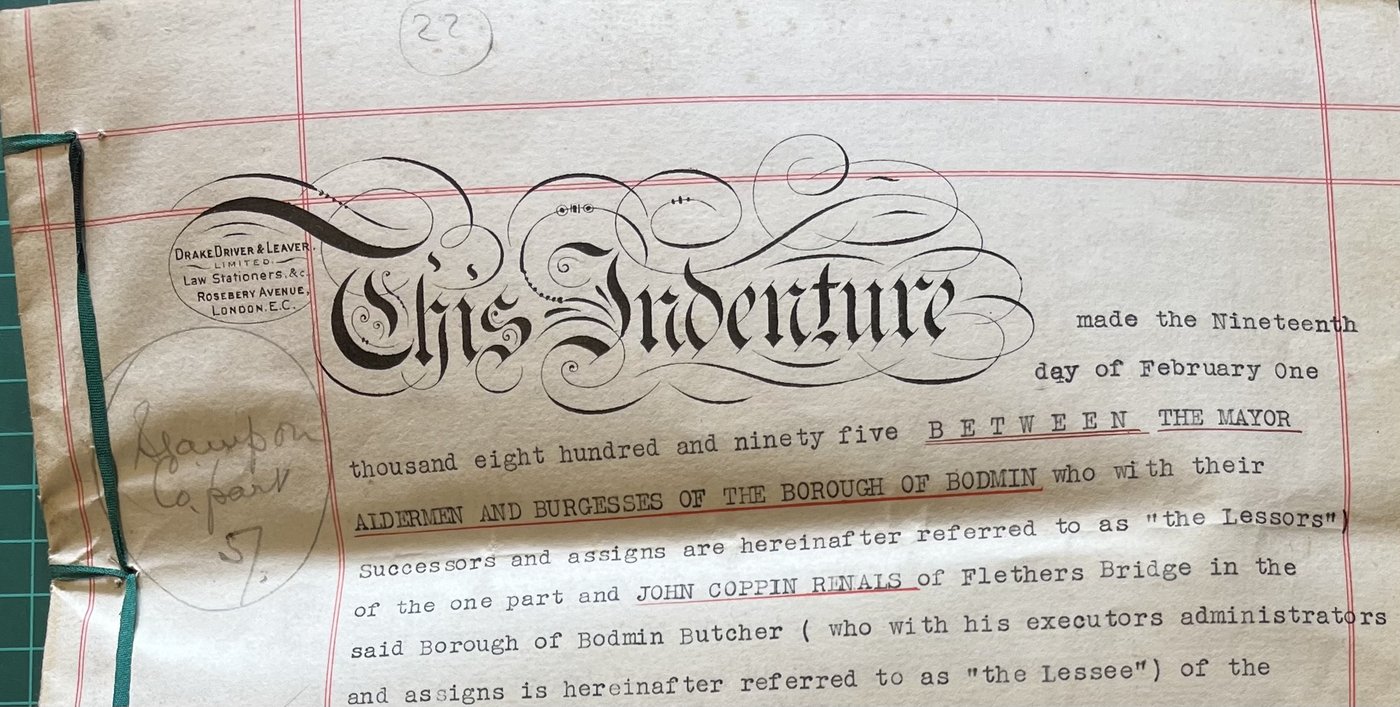 Opening of the 1895 reversionary lease, naming John Coppin Renals "of the said Borough of Bodmin, Butcher"
By 1895, John Coppin Renals held the leasehold interest in land near Lower Margate originally granted to his grandfather Francis Rennals by the Mayor, Aldermen and Burgesses of Bodmin on 22 September 1832 — a 99-year lease determinable on the lives of three of Francis's children: James, Henry and Grace Rennalls, then aged 14, 12 and 5 respectively. (See the James Renals page for the full 1840 document and the story of this clause's confirmation.)
The lease recites that Henry Rennalls died on 21 January 1894 — a new, precisely dated fact for the family record. Under the terms of the original 1832 covenant, this entitled the leaseholder to apply for a renewed lease naming a new life in Henry's place, provided this was done within three months of the death and terms agreed with the Corporation.
John did exactly this. By an indenture dated 19 February 1895, for a consideration of £72 paid to the Mayor, Aldermen and Burgesses, a renewed 99-year lease was granted — now determinable on the survivor of James and Grace Rennalls, and thereafter on the life of a newly named third party: Philip Riddle of Kingswood, Cardinham, farmer, then aged about nineteen. The new yearly rent was set at 17 shillings and sixpence.
The land itself is described in this lease as "fields and a Cottage," numbered 1328, 1329, 1330 and 1331 on the Tithe Apportionment Map and Book of Reference for the Borough of Bodmin, containing 4 acres, 3 roods and 18 perches — a larger, cottage-bearing holding distinct from the three-acre North Park close dealt with separately by John's uncle, John Rennals the blacksmith at Margate.
The document was drawn up by John Pethybridge, solicitor of Bodmin, and witnessed by E. V. George, clerk to Mr R. P. Edyvean, solicitor, Bodmin.
Source: original document ("No. 126," reversionary lease), photographed by Andy Renals, 3 August 2026, using an iPhone 13. Private collection (Kevin and Angela Renals bundle, 1840–1929).
1898 — Lease of Inclosure Turf Down, opposite Bazeley's Barn
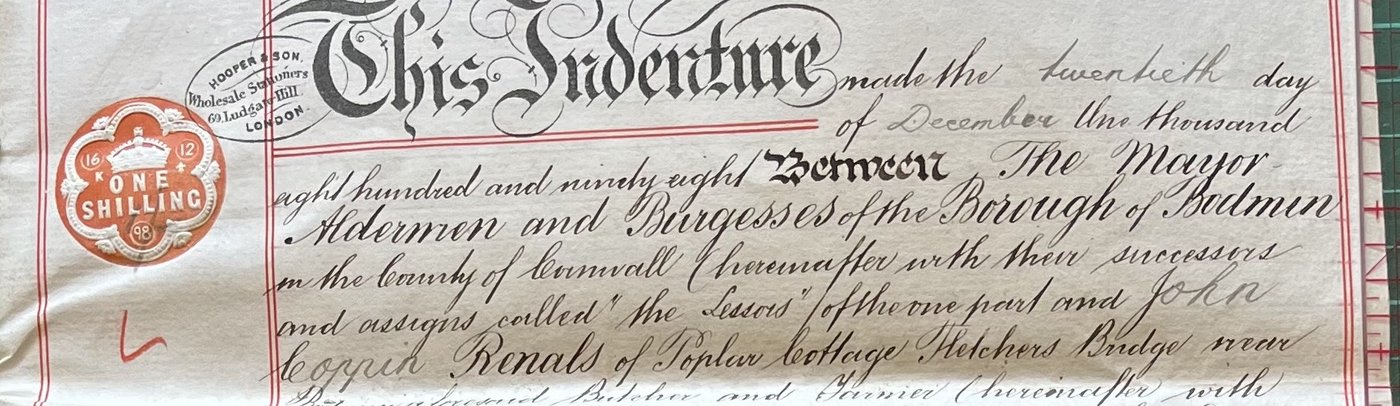 Opening of the 1898 lease of Inclosure Turf Down, with its one shilling duty stamp
By a further lease dated 20 December 1898 (No. 153), the Mayor, Aldermen and Burgesses of Bodmin let to John Coppin Renals — now styled "of Poplar Cottage, Fletchers Bridge, Butcher and Farmer" — four fields (formerly two), known as "Inclosure Turf Down," situated opposite Bazeley's Barn on the road from Bodmin to Bodmin Road. The land, lately in the occupation of William Chapman, contained 7 acres, 2 roods and 14 perches, numbered 1368 and 1371 on the Tithe Apportionment Map for the Parish of Bodmin.
The term was 14 years from Michaelmas (29 September) 1898, expiring 29 September 1912, at a yearly rent of £7 5s 6d, paid quarterly. The lease sets out detailed covenants of good husbandry — manuring rates for pasture and tillage, restrictions on ploughing or hay-cutting in the final three years of the term, and the usual repair and forfeiture provisions typical of agricultural leases of the period.
The lease was sealed with the Common Seal of the Borough, signed by Robert L. S. Roscorla, Mayor, and witnessed by R. P. Edyvean, Town Clerk.
A note on Bazeley's Barn: this is the same Bazeley's Barn where, a generation later, Bob Renals and Charlotte Orchard raised their sons Edwin John and Roy Frederick — the latter being the father of Andrew James, builder of this family history. The 1898 lease describes the land in question simply as lying "opposite" the barn, showing the name was already a well-established local landmark by that date. A later map also shows "Bazeley's Plantation," a stand of trees between the barn and what would become the family's later home. The field in front of Bazeley's Barn cottage is today leased by the National Trust for regular Saturday car boot sales in the summer months. It seems likely — though not yet verified — that the wider estate passed at some point from Bodmin's Corporation or another local owner into the hands of the Agar-Robartes family of Lanhydrock, and from them eventually to the National Trust; this chain of ownership is worth confirming with a proper records search.
Source: original document ("No. 153"), photographed by Andy Renals, 3 August 2026, using an iPhone 13. Private collection (Kevin and Angela Renals bundle, 1840–1929).
1907 — Lease of Bove Town, New Inclosure and Orchard, Turf Down
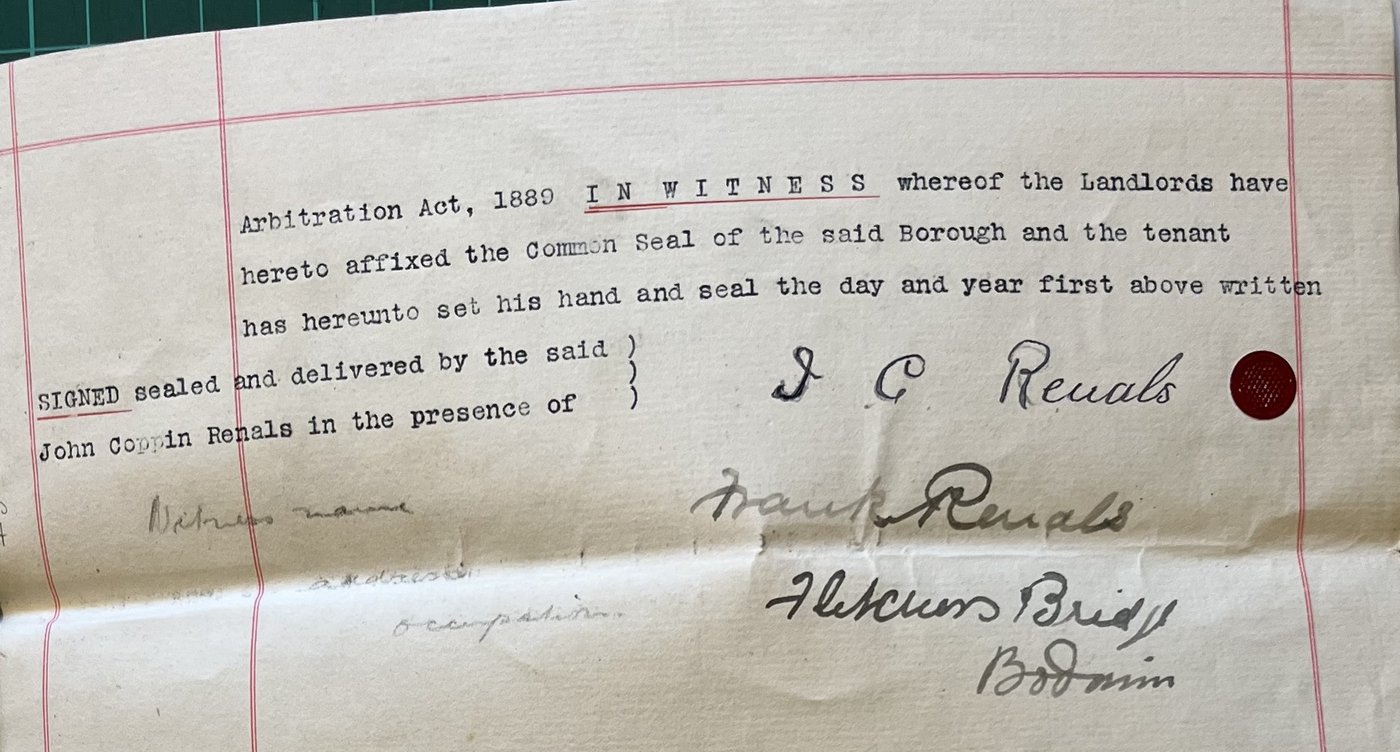 John Coppin Renals's own signature and seal, witnessed by his brother Frank Renals of Fletchers Bridge
By a lease dated 24 September 1907 (No. 125a), the Mayor, Aldermen and Burgesses of Bodmin let to John Coppin Renals — now styled simply "of Poplar Cottage, Fletchers Bridge, Bodmin, Farmer," with no further mention of the butcher's trade — three fields or closes at Turf Down, numbered 1337, 1338 and 1339 on the Tithe Map for the Parish of Bodmin, individually described as "Bove Town," "New Inclosure" and "Orchard," containing together 9 acres and 17 perches, and numbered 125a in the Terrier of the Borough's Corporate property.
This is a separate holding from the 1898 lease of "Inclosure Turf Down" (fields 1368 and 1371), meaning that by 1907 John Coppin Renals held at least two distinct parcels in the Turf Down area under different lease numbers — evidence of an expanding farming operation.
The term was 14 years from 29 September 1906, at a yearly rent of £13 2s 6d, quarterly, with a penalty rent of £20 per acre for misuse — steeper than the £10 per acre penalty in the 1898 lease. The husbandry covenants follow the same standard formula seen in the 1898 lease (20 cart-loads of dung or equivalent lime per acre for hay and corn land; 3 cwt Peruvian guano or 6 cwt dissolved bone per acre for turnip and green crops), suggesting a common printed template used by the Corporation across these years. For the first time in the family's surviving documents, this lease also includes an explicit end-of-term compensation clause, requiring the Landlords to pay the tenant for growing crops, hay and straw left at the close of the term, with disputes settled by arbitration under the Arbitration Act 1889.
Both the Lease (retained by the Corporation, bearing John Coppin Renals's own signature and seal) and its Counterpart (retained by the tenant, bearing the Borough's Common Seal and the signatures of the Mayor and Town Clerk) survive in the family's collection. The Lease is witnessed by Frank Renals of Fletchers Bridge — very likely John Coppin's own brother, Francis Renals, born about 1861 — a nice instance of one generation of the family formally witnessing another's dealings. (This Frank Renals should not be confused with the later Frank W Renals, born 19 July 1940.)
The Counterpart is signed by Thos. S. Hore, Mayor, and John Pethybridge, Town Clerk — the same John Pethybridge who, as a solicitor, drew up the 1895 reversionary lease, and who by 1907 had become Town Clerk of Bodmin.
Source: original documents (Lease and Counterpart, "No. 125a"), photographed by Andy Renals, 3 August 2026, using an iPhone 13. Private collection (Kevin and Angela Renals bundle, 1840–1929).
1912 — Renewal lease of Inclosure Turf Down, with plan
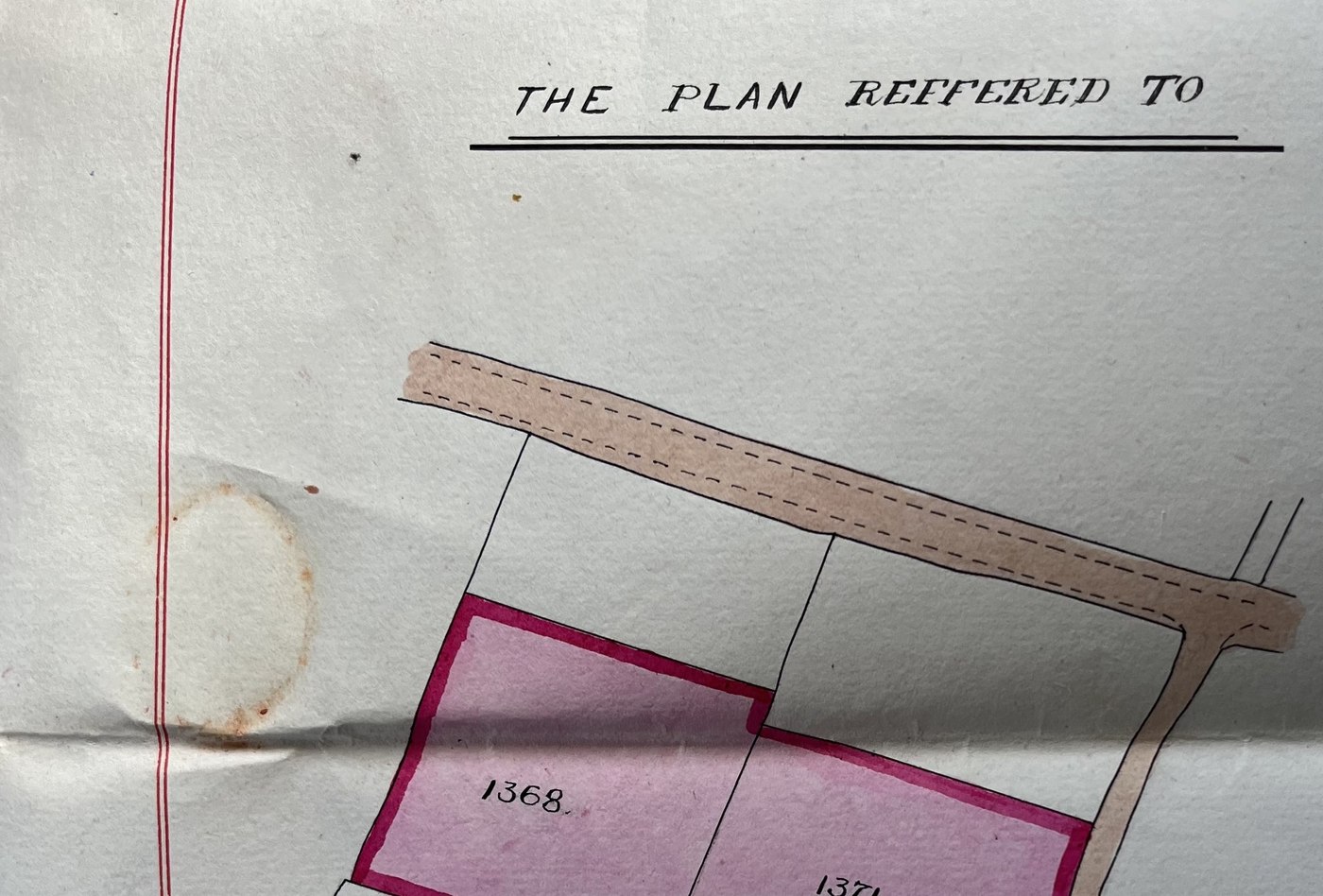 The plan referred to in the 1912 renewal lease, showing fields 1368 and 1371 bordering the road to Bodmin
By a further lease dated 9 November 1912 (still numbered 153, the same lease number as the 1898 document), the Mayor, Aldermen and Burgesses of Bodmin renewed John Coppin Renals's tenancy of the same two fields at Turf Down — numbers 1368 and 1371 on the Tithe Map — for a further term of 14 years from 29 September 1912, expiring 28 September 1926, at the same yearly rent of £7 5s 6d.
This lease includes, for the first time in the family's surviving documents, a proper schedule and a hand-drawn, coloured plan of the land — showing the two fields side by side, bordered by the road along their northern edge, almost certainly the same road "leading from Bodmin to Bodmin Road" described in the 1898 lease as running past Bazeley's Barn.
The schedule confirms the fields' combined area as 7 acres, 2 roods and 14 perches, exactly matching the figure given in 1898 — firm confirmation that this is a straightforward renewal of the same holding, not a new or altered parcel.
The husbandry covenants are somewhat more detailed than in the earlier leases, adding explicit obligations to trim, lay and plash hedges once a year, to control moles and vermin, and to cleanse ditches, gutters and watercourses annually. For the first time, the Landlords also covenant to keep the walls, slated roofs and main timbers of the farmhouse and buildings in good repair — a shift toward shared responsibility for the property's upkeep.
Signed by William J. P. Jenkins, Mayor, and John Pethybridge, Town Clerk — Pethybridge's fourth appearance across these documents, spanning 1895 to 1912.
Source: original documents (Lease, schedule and plan, "No. 153"), photographed by Andy Renals, 3 August 2026, using an iPhone 13. Private collection (Kevin and Angela Renals bundle, 1840–1929).
1929 — Renewal lease of four fields at Turfdown, with plan
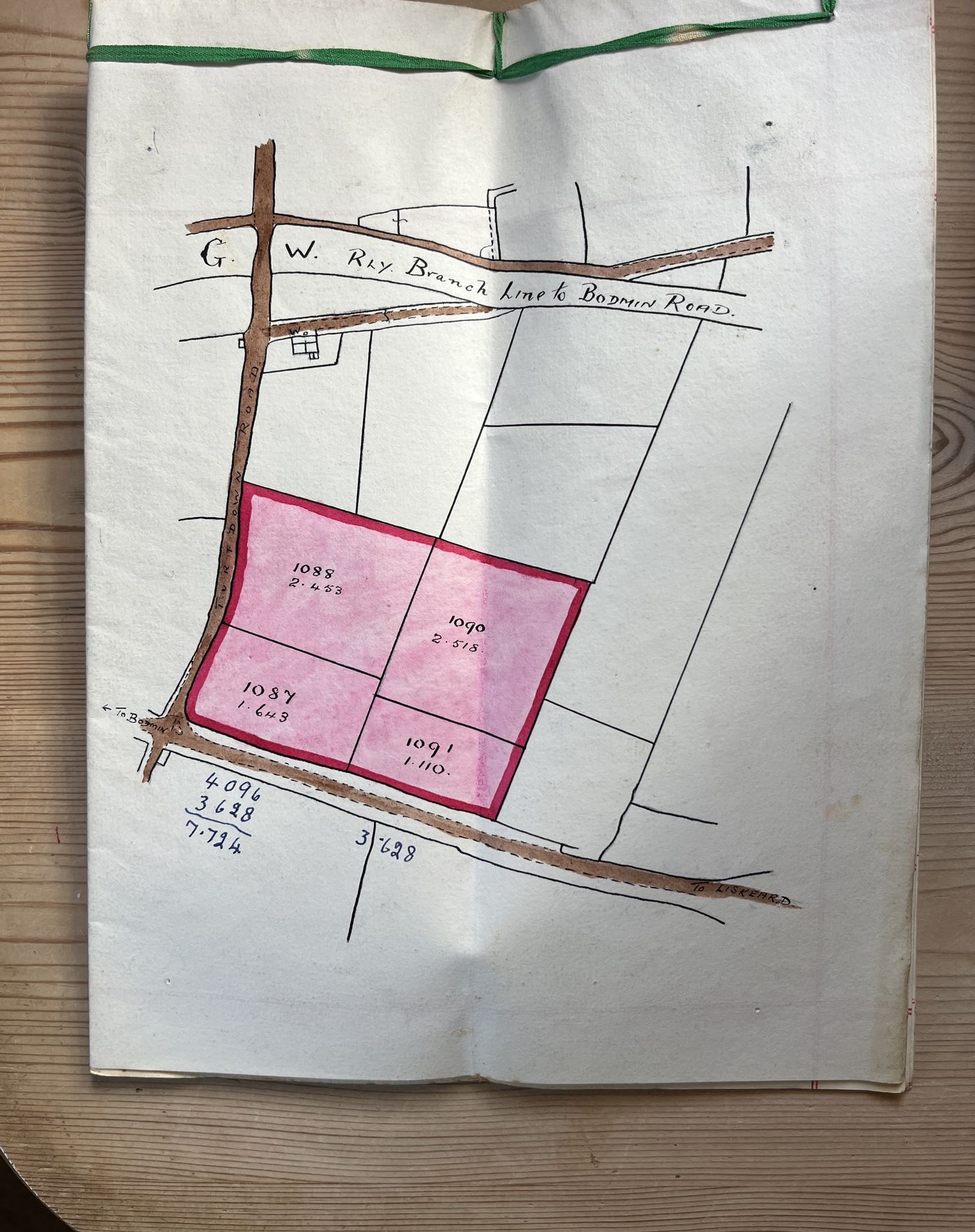 The plan referred to in the 1929 renewal lease, showing all four fields at Turfdown alongside the Bodmin branch railway line and the roads to Bodmin and Liskeard
By a further lease dated 5 March 1929 (still Lease No. 153), the Mayor, Aldermen and Burgesses of Bodmin renewed John Coppin Renals's tenancy of four fields at Turfdown for a further term of 14 years from 29 September 1926, expiring 1940, at the same yearly rent of £7 5s 6d.
This lease is the first to cross-reference the fields against both the Tithe Map and the Ordnance Survey Map, revealing that the single Tithe Map numbers used in the earlier leases each corresponded to two smaller Ordnance Survey fields:
| Tithe No. | Ordnance No. | Field | A. r. p. |
|---|---|---|---|
| 1368 | 1090 | Field | 2. 2. 3 |
| 1091 | Field | 1. 0. 17 | |
| 1371 | 1088 | Field | 2. 1. 32 |
| 1087 | Field | 1. 2. 22 | |
| Total | 7. 2. 34 |
The accompanying plan shows all four fields coloured pink, with their areas given in decimal acres (2.453, 2.518, 1.643 and 1.110, totalling 7.724 acres, noted in blue ink on the plan itself) — matching the schedule's figure closely, the small difference being simply the conversion between acres-roods-perches and decimal acres. The plan is the most detailed of the collection, showing the surrounding roads, the railway line, and what appears to be a small building near the road junction.
For the first time in the family's documents, this lease explicitly invokes the Agricultural Holdings Act 1923 in setting out the tenant's obligations for manure and cultivation — reflecting the modernisation of agricultural tenancy law by this date. The covenants are otherwise a tidied, numbered restatement of those seen in 1912, covering hedges, ditches, moles and rats, weeds, and a limit of one-third of the land in tillage at any time.
Signed by E. J. P. Burton, Mayor, and once again John Pethybridge, Town Clerk — his fifth appearance across this family's documents, spanning 1895 to 1929, a run of 34 years.
A note on the railway shown on the plan: the "G.W. Rly Branch Line to Bodmin Road" marked on this plan refers to the Bodmin branch line, opened in 1887, connecting Bodmin General station to Bodmin Road (now Bodmin Parkway) on the Cornwall Railway's Plymouth–Falmouth main line, which had opened in 1859. Bodmin Road/Parkway owed its existence in part to the Agar-Robartes family of nearby Lanhydrock House, who had a driveway built connecting the house directly to the station, easing travel for visiting dignitaries including prime ministers. The line traced on this plan is preserved and operating today, run by the Bodmin Railway Heritage Trust, with steam trains still climbing the same route toward Bodmin Parkway.
Source: original documents (Lease, schedule and plan, "No. 153"), photographed by Andy Renals, 3 August 2026, using an iPhone 13. Private collection (Kevin and Angela Renals bundle, 1840–1929).
Outstanding questions
- Is Philip Riddle of Kingswood, Cardinham connected to the wider Coppin/Riddle family (via Richard Coppin's wife, Elizabeth Riddle, or the Kingswood Bible Christian meetings)? Worth checking, given the coincidence of both name and place.
- Worth locating parcels 1328–1331 on the Bodmin Tithe Apportionment Map, ideally via the National Library of Scotland viewer, to place this holding precisely alongside North Park.
- Worth confirming the chain of ownership by which the Turf Down/Bazeley's Barn land passed from the Borough of Bodmin (or another local owner) to the Agar-Robartes family of Lanhydrock, and eventually to the National Trust.
- Who was the previous tenant "Mr John Mudge," named in the 1892 lease as lately occupying the Turf Down land — and is he connected to Henry Mudge, surgeon, the mortgagee in the 1841/1847 documents?
- Why is John Coppin Renals styled "the younger" in the 1892 lease alone? Was there another John Coppin Renals or John Renals senior active at the time?
A note on the surname: John's own leases consistently style him "Renals," while his father James's will and probate documents use "Runnals" — see A Note on the Spelling of Renals for what the surviving records show.